Describes the one-way flow of genetic information from DNA to RNA to protein, highlighting the irreversibility of protein synthesis from nucleic acids.
Transcription
The process where RNA is synthesized using a DNA template, resulting in a complementary RNA strand, primarily mRNA.
Translation
The cellular process where ribosomes use mRNA sequences to assemble amino acids into a polypeptide chain, forming proteins.
Promoter
A specific DNA sequence where RNA polymerase binds to initiate transcription of a gene.
Terminator
A DNA sequence signaling the end of transcription, causing RNA polymerase to release the newly made RNA.
RNA Polymerase
The primary enzyme responsible for synthesizing RNA from a DNA template during transcription, without requiring a primer.
Pre-mRNA
The initial RNA transcript produced in eukaryotes, containing both introns and exons, and requiring processing before translation.
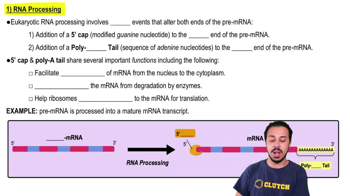
5' Cap
A modified guanine nucleotide added to the 5' end of pre-mRNA, aiding in nuclear export, stability, and ribosome attachment.
Poly-A Tail
A stretch of adenine nucleotides added to the 3' end of pre-mRNA, enhancing mRNA stability and facilitating export from the nucleus.
Intron
A noncoding region within a gene or pre-mRNA that interrupts coding sequences and is removed during RNA splicing.
Exon
A coding region within a gene or mRNA that remains after splicing and is ultimately translated into protein.
Spliceosome
A large RNA-protein complex responsible for removing introns and joining exons during RNA splicing in eukaryotes.
Alternative Splicing
A process allowing a single gene to produce multiple mRNA variants by varying the combination of exons included in the final transcript.
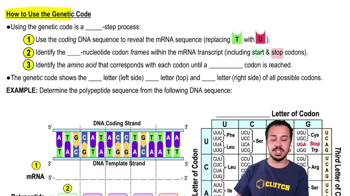
Genetic Code
A universal set of rules that translates mRNA codons into specific amino acids, linking nucleic acid sequences to protein structure.
Codon
A three-nucleotide sequence in mRNA that specifies a particular amino acid or signals termination during translation.
Anticodon
A three-nucleotide sequence on tRNA that pairs with a complementary mRNA codon during translation.
Ribosome
A complex molecular machine composed of rRNA and proteins, serving as the site of protein synthesis during translation.
tRNA
A type of RNA molecule that carries specific amino acids to the ribosome, matching its anticodon to mRNA codons during translation.
Post-Translational Modification
Covalent chemical changes to a protein after translation, such as methylation or phosphorylation, altering protein function or stability.
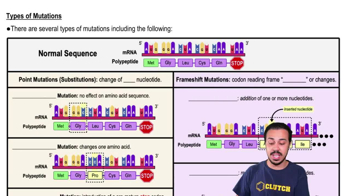
Mutation
A permanent alteration in the DNA sequence, potentially affecting RNA and protein products, and contributing to genetic diversity.
Point Mutation
A genetic change involving the substitution of a single nucleotide, which may be silent, missense, or nonsense in effect.
Frameshift Mutation
A genetic alteration caused by insertion or deletion of nucleotides, shifting the reading frame and altering downstream amino acids.
 Back
Back
 08:44
08:44