It describes the unidirectional flow of genetic information from DNA to RNA (transcription) and from RNA to protein (translation).
What is the role of RNA polymerase in transcription?
RNA polymerase is the primary enzyme that synthesizes RNA from a DNA template, starting at the promoter region.
What is the function of the promoter in a gene?
The promoter is a DNA sequence where transcription begins and where RNA polymerase binds to initiate RNA synthesis.
What is the difference between upstream and downstream DNA sequences relative to a gene?
Upstream refers to DNA sequences opposite the direction of transcription, while downstream refers to sequences in the same direction as transcription.
What modifications occur during eukaryotic RNA processing?
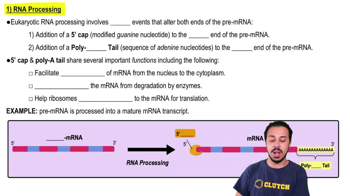
A 5' cap (modified guanine) is added to the 5' end and a poly-A tail (adenine nucleotides) is added to the 3' end of pre-mRNA.
Why are the 5' cap and poly-A tail important for mRNA?
They facilitate mRNA export from the nucleus, protect it from degradation, and help ribosomes attach for translation.
What is RNA splicing and what does it accomplish?
RNA splicing removes introns (noncoding regions) from pre-mRNA and reconnects exons (coding regions) to produce mature mRNA.
What is the function of the spliceosome?
The spliceosome is a large complex of RNA and protein that removes introns and splices exons together in pre-mRNA.
What is alternative RNA splicing?
Alternative RNA splicing allows a single gene to be spliced in different ways, producing multiple protein products.
What is a codon and how is it used in translation?
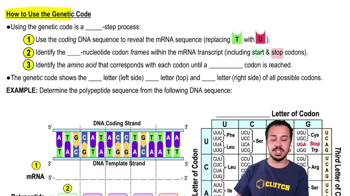
A codon is a three-nucleotide sequence in mRNA that specifies a particular amino acid during translation.
What is the role of tRNA in translation?
tRNA carries amino acids to the ribosome and pairs its anticodon with the mRNA codon to ensure correct amino acid placement.
What is the difference between charged and discharged tRNA?
Charged tRNA is attached to an amino acid, while discharged tRNA is not attached to an amino acid.
What are post-translational modifications and name four common types?
Post-translational modifications are covalent changes to proteins after translation; common types include methylation, acetylation, ubiquitination, and phosphorylation.
What is a mutation and how can it affect gene expression?
A mutation is a permanent change in the DNA sequence, which can alter RNA and protein synthesis, affecting protein function.
What is the difference between point mutations and frameshift mutations?
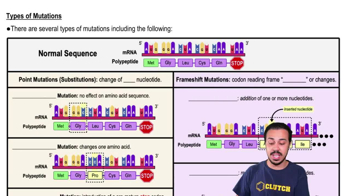
Point mutations change a single nucleotide without altering the reading frame, while frameshift mutations (insertions or deletions) shift the codon reading frame, affecting downstream amino acids.
 Back
Back
 08:44
08:44