Skip to main content
Anatomy & Physiology
My Course
Learn
Exam Prep
AI Tutor
Study Guides
Textbook Solutions
Flashcards
Explore
Try the app
My Course
Learn
Exam Prep
AI Tutor
Study Guides
Textbook Solutions
Flashcards
Explore
Try the app
Back
Genetic Disorders definitions
You can tap to flip the card.
Autosome
You can tap to flip the card.
👆
Autosome
Any chromosome not involved in determining sex, carrying genes for traits inherited equally by males and females.
Track progress
Control buttons has been changed to "navigation" mode.
1/15
Related flashcards
Related practice
Recommended videos
Genetic Disorders quiz #1
Genetic Disorders
10 Terms
Genetic Disorders
29. Heredity
3 problems
Topic
Gene Therapy
29. Heredity
3 problems
Topic
29. Heredity
5 topics
9 problems
Chapter
Bruce
Guided course
05:21
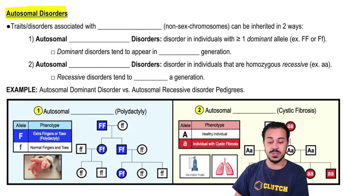
Autosomal Disorders
362
views
4
rank
Guided course
03:42
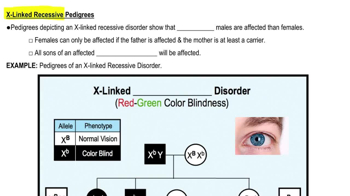
X-Linked Recessive Pedigrees
301
views
3
rank
Guided course
04:37
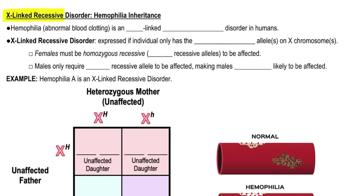
X-Linked Recessive Disorder: Hemophilia Inheritance
323
views
2
rank
Terms in this set (15)
Hide definitions
Autosome
Any chromosome not involved in determining sex, carrying genes for traits inherited equally by males and females.
Dominant Allele
A gene variant that expresses its trait even when only one copy is present in the genotype.
Recessive Allele
A gene variant whose trait is only expressed when two copies are present in the genotype.
Homozygous
A genetic condition where both alleles for a trait are identical, either both dominant or both recessive.
Heterozygous
A genetic condition where two different alleles for a trait are present in the genotype.
Pedigree
A diagram showing inheritance patterns of traits or disorders across multiple generations in a family.
Polydactyly
A condition characterized by the presence of extra fingers or toes, resulting from a dominant allele.
Cystic Fibrosis
A disorder caused by two recessive alleles, leading to thick mucus production and respiratory issues.
Hemophilia
A disorder marked by abnormal blood clotting, often due to a recessive gene on the X chromosome.
X Chromosome
A sex chromosome carrying genes that can cause certain disorders, especially when recessive alleles are present.
Carrier
An individual with one normal and one altered allele for a recessive disorder, showing no symptoms but able to pass it on.
Punnett Square
A grid used to predict the possible genetic outcomes of a cross between two individuals.
Red-Green Color Blindness
A vision disorder caused by a recessive allele on the X chromosome, affecting color perception.
Generation Skipping
A pattern where a genetic disorder appears in alternate generations, typical of recessive inheritance.
X-Linked Recessive Disorder
A condition resulting from a recessive gene on the X chromosome, more common in males due to their single X.
 BackBack
 05:21
05:21