Back

Ionic Bonding quiz

Control buttons has been changed to "navigation" mode.
1/15
  • What is an ion?

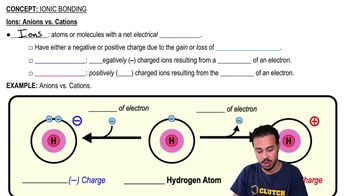
    An ion is an atom or molecule with a net electrical charge, either positive or negative, due to the gain or loss of electrons.
  • How does an atom become an anion?

    An atom becomes an anion by gaining one or more negatively charged electrons, resulting in a net negative charge.
  • How does an atom become a cation?

    An atom becomes a cation by losing one or more negatively charged electrons, resulting in a net positive charge.
  • What is the main difference between anions and cations?

    Anions are negatively charged ions, while cations are positively charged ions.
  • What happens to a neutral hydrogen atom if it gains an electron?

    It becomes an anion with a net negative charge because it has more electrons than protons.
  • What happens to a neutral hydrogen atom if it loses its electron?

    It becomes a cation with a net positive charge because it has only a proton and no electrons.
  • What is an ionic bond?

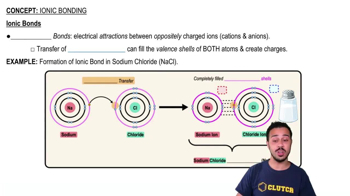
    An ionic bond is an electrical attraction between oppositely charged ions, specifically cations and anions.
  • Do ionic bonds involve sharing of electrons?

    No, ionic bonds involve a complete transfer of electrons, not sharing.
  • Why do atoms undergo ionic bonding?

    Atoms undergo ionic bonding to achieve full valence shells, which increases their stability.
  • What is the role of electronegativity in ionic bonding?

    A large difference in electronegativity between atoms causes one atom to completely transfer an electron to another, forming ions.
  • Describe the electron transfer in the formation of sodium chloride (NaCl).

    Sodium loses an electron to become a cation, and chlorine gains that electron to become an anion, resulting in an ionic bond.
  • What happens to the valence shells of sodium and chlorine after electron transfer?

    Both sodium and chlorine achieve full valence shells after the electron transfer, making them stable ions.
  • What charges do sodium and chloride ions have after ionic bonding?

    Sodium ion has a positive charge, and chloride ion has a negative charge.
  • What everyday substance is formed by the ionic bond between sodium and chloride ions?

    Table salt, or sodium chloride (NaCl), is formed by the ionic bond between sodium and chloride ions.
  • What causes the attraction in an ionic bond?

    The attraction is caused by the opposite charges of the cation and anion created after electron transfer.