Back

Post-Translational Modification quiz

Control buttons has been changed to "navigation" mode.
1/15
  • What is the main purpose of post-translational modifications (PTMs)?

    PTMs control protein activity after translation by covalently modifying the protein. These modifications can alter the protein's function, stability, or location.
  • When do post-translational modifications occur in relation to translation?

    They occur after translation has been completed. This is why they are called 'post-translational' modifications.
  • What does the abbreviation PTM stand for?

    PTM stands for post-translational modification. It refers to covalent changes made to proteins after translation.
  • Which four PTMs are most commonly recommended to study?

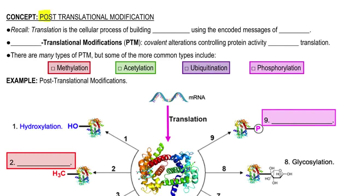
    Methylation, acetylation, ubiquitination, and phosphorylation are the four most commonly recommended PTMs. These are frequently emphasized in courses.
  • What is methylation in the context of PTMs?

    Methylation is the addition of a methyl group (CH3) to a protein. This covalently modifies the protein's structure and function.
  • What group is added to a protein during acetylation?

    An acetyl group is added to the protein during acetylation. This modification can affect the protein's activity and interactions.
  • What is ubiquitination and what is added to the protein?

    Ubiquitination is the addition of a ubiquitin protein to another protein. Ubiquitin is a small protein that tags proteins for degradation or other cellular processes.
  • What is phosphorylation and what does it add to proteins?

    Phosphorylation is the addition of a phosphate group to a protein. This modification often regulates protein activity.
  • What is hydroxylation in PTMs?

    Hydroxylation is the addition of a hydroxyl group to a protein. This can affect the protein's stability and function.
  • What does lipidation add to a protein?

    Lipidation adds a lipid molecule to a protein. This modification can target proteins to membranes.
  • What is the function of disulfide bonds as a PTM?

    Disulfide bonds covalently link parts of the same protein or different proteins. They help stabilize protein structure.
  • What is sulfonation (or sulfation) in PTMs?

    Sulfonation is the addition of a sulfur group to a protein. This can influence protein-protein interactions.
  • What is glycosylation and what is added to the protein?

    Glycosylation is the addition of a carbohydrate group to a protein. This modification can affect protein folding and cell signaling.
  • Why might the specific PTMs you need to study vary?

    The specific PTMs to focus on can depend on your course or instructor's requirements. Not all PTMs are emphasized equally in every curriculum.
  • What is the general effect of PTMs on proteins?

    PTMs can alter a protein's function, stability, localization, or interactions. They are essential for regulating protein activity in the cell.