Back

Resting Membrane Potential quiz

Control buttons has been changed to "navigation" mode.
1/15
  • What is the typical value of the resting membrane potential in central nervous system neurons?

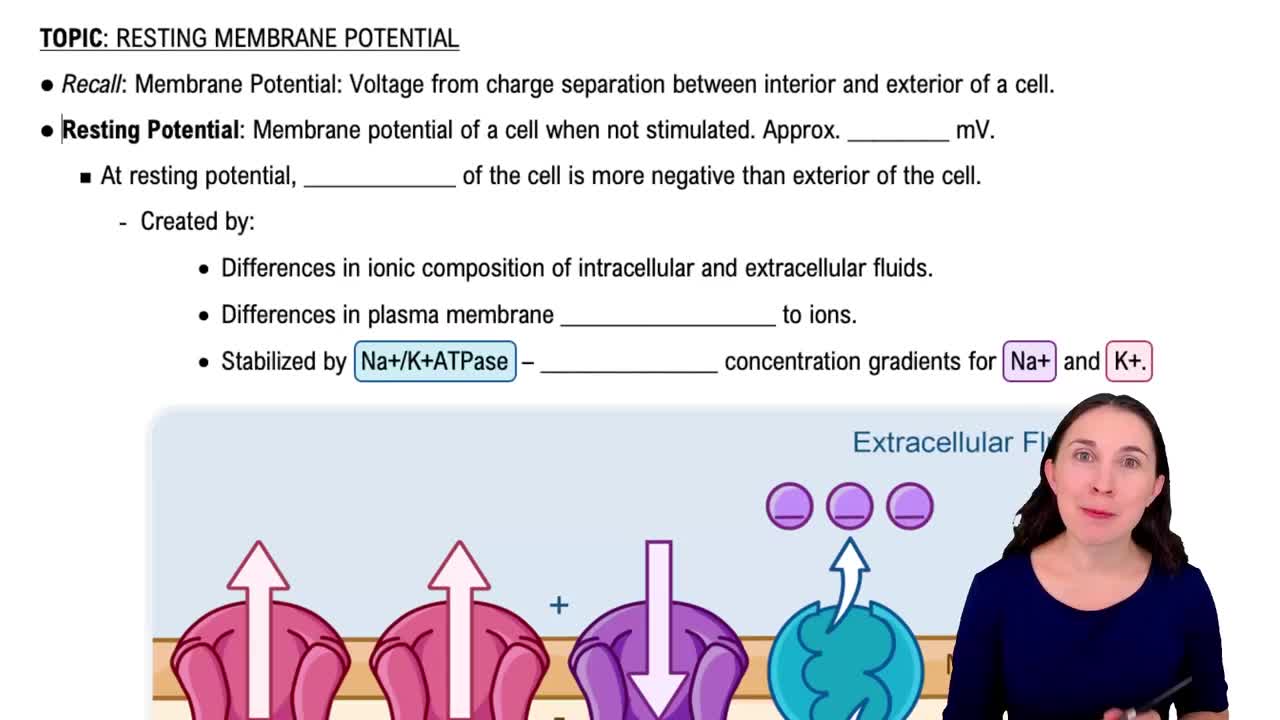
    The typical resting membrane potential in CNS neurons is about -70 millivolts, but it can range from -40 to -90 millivolts depending on the neuron type.
  • What does the term 'membrane potential' refer to?

    Membrane potential refers to the voltage created by the separation of charges across the cell membrane, with the inside and outside of the cell having different charges.
  • Which two main factors create the resting membrane potential?

    The resting membrane potential is created by differences in ionic composition (mainly sodium and potassium) and differences in membrane permeability to these ions.
  • Where is sodium concentration higher, inside or outside the neuron at rest?

    Sodium concentration is higher outside the neuron when the cell is at rest.
  • Why is the neuron's membrane more permeable to potassium than sodium?

    The neuron's membrane is more permeable to potassium because there are more potassium leak channels than sodium leak channels.
  • What is the main role of potassium ions in establishing resting membrane potential?

    Potassium ions play a crucial role because their movement out of the cell through leak channels makes the cell interior more negative.
  • How does the sodium-potassium pump help maintain resting membrane potential?

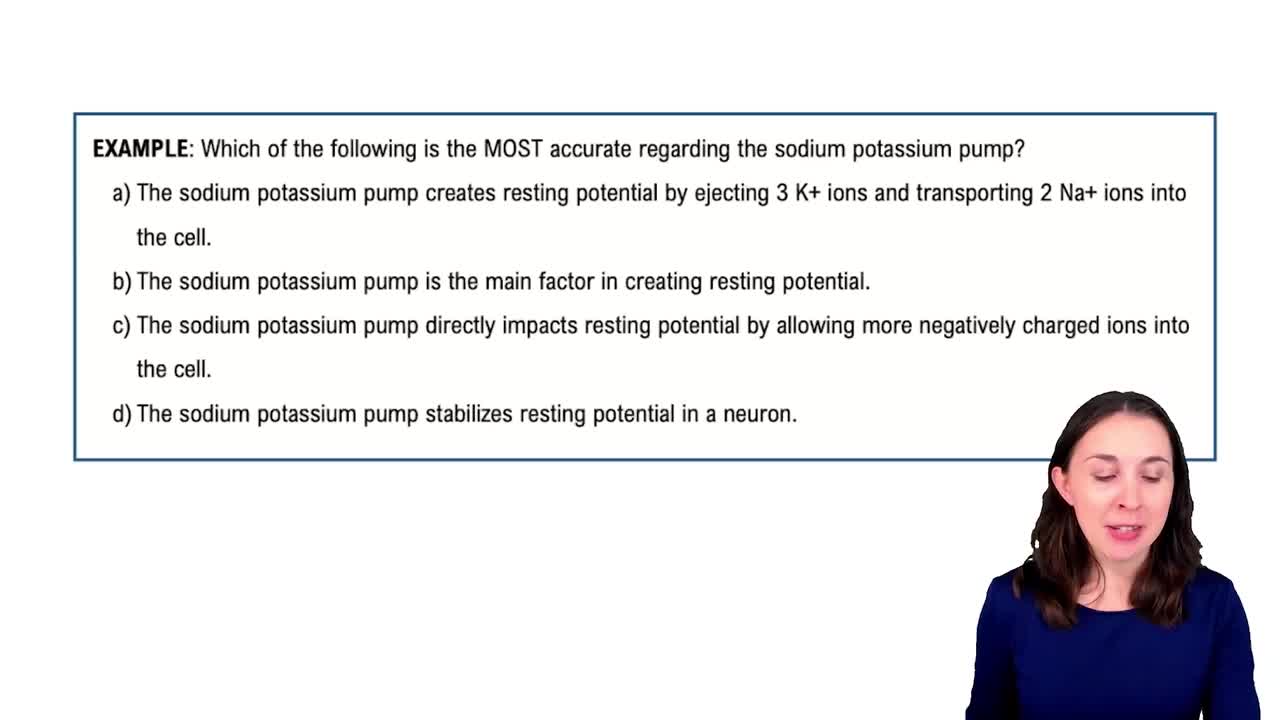
    The sodium-potassium pump maintains the resting potential by ejecting 3 sodium ions out and bringing 2 potassium ions in, preserving the concentration gradients.
  • Why is the inside of the cell negative despite high potassium levels inside?

    The cell interior is negative because potassium leaks out, and there are also negatively charged proteins and other ions inside the cell.
  • What would happen if the sodium-potassium pump stopped working?

    If the pump stopped, ion diffusion rates would become unstable, potentially making the cell interior too negative and impairing neuron communication.
  • What is the 'Goldilocks zone' in the context of resting membrane potential?

    The 'Goldilocks zone' refers to maintaining the resting potential at just the right level (about -70 mV), with balanced ion movement.
  • Besides sodium and potassium, what else contributes to the negative charge inside the cell?

    Negatively charged proteins and other ions inside the cytosol also contribute to the cell's negative interior.
  • Why are there so many potassium leak channels in neurons?

    Potassium leak channels help establish resting potential and are also involved in functions like pain signaling and sleep regulation.
  • What is the effect of potassium leaking out of the neuron?

    Potassium leaking out causes the inside of the cell to become more negative relative to the outside.
  • How many sodium and potassium ions does the sodium-potassium pump move per cycle?

    The pump moves 3 sodium ions out of the cell and 2 potassium ions into the cell per cycle.
  • Why is it important to maintain the resting membrane potential within a certain range?

    Maintaining the resting potential within a certain range ensures proper neuron function and communication; too much deviation can impair signaling.