 Back
BackEndocrine System: Structure, Function, and Hormonal Regulation
Study Guide - Smart Notes
 Tailored notes based on your materials, expanded with key definitions, examples, and context.
Endocrine System Overview
Definition and Function
The endocrine system is a network of glands that produce and release hormones to regulate various bodily functions, including growth, metabolism, and homeostasis. Unlike the nervous system, which uses electrical signals, the endocrine system relies on chemical messengers (hormones) that travel through the bloodstream to distant target organs.
Hormones: Chemical messengers released into the bloodstream, influencing growth, development, and metabolic activities.
Tropic hormones: Hormones that activate other endocrine glands to release their hormones or act on target organs.
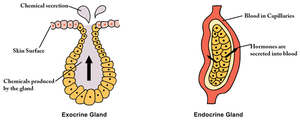
Image explanation: The image compares exocrine glands (which secrete chemicals onto body surfaces or into ducts) and endocrine glands (which secrete hormones directly into the bloodstream).
Primary and Secondary Endocrine Organs
Endocrine organs are classified as primary (main function is hormone secretion) or secondary (hormone secretion is a secondary function).
Primary endocrine organs: Pituitary gland, pineal gland, thyroid, parathyroid, adrenal glands, pancreas, ovaries, testes, placenta (during pregnancy).
Secondary endocrine organs: Skin, heart, liver, stomach, kidney, small intestine.
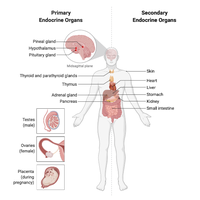
Image explanation: The image shows the anatomical locations of primary and secondary endocrine organs in the human body.
Pituitary Gland and Hypothalamus
Structure and Functional Relationships
The pituitary gland is often called the "master gland" because it regulates many other endocrine glands. It is divided into the anterior and posterior lobes, each with distinct connections to the hypothalamus:
Anterior pituitary: Connected to the hypothalamus by the hypophyseal portal system (a network of blood vessels).
Posterior pituitary: Connected to the hypothalamus via the hypothalamo-hypophyseal tract (nerve axons).
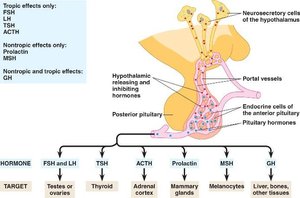
Image explanation: The image illustrates the hypothalamic-pituitary axis, showing hormone release pathways and target organs.
Hormones of the Pituitary Gland
The pituitary gland releases several hormones that regulate various physiological processes:
Anterior pituitary hormones: Growth hormone (GH), thyroid-stimulating hormone (TSH), adrenocorticotropic hormone (ACTH), prolactin (PRL), follicle-stimulating hormone (FSH), luteinizing hormone (LH), melanocyte-stimulating hormone (MSH).
Posterior pituitary hormones: Antidiuretic hormone (ADH/vasopressin), oxytocin.
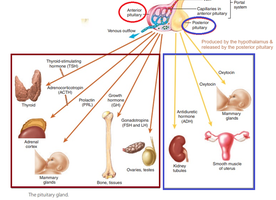
Image explanation: The image shows the target organs and effects of anterior and posterior pituitary hormones.
Anterior Pituitary Hormones: Regulation and Effects
The anterior pituitary is regulated by hypothalamic releasing and inhibiting hormones. Each hormone has specific targets and effects:
Releasing Hormone | Pituitary Hormone | Target | Effects |
|---|---|---|---|
GnRH | LH, FSH | Reproductive system | Stimulates production of sex hormones and gametes |
TRH | TSH | Thyroid gland | Stimulates release of thyroid hormones (regulates metabolism) |
CRH | ACTH | Adrenal cortex | Stimulates release of glucocorticoids (stress response) |
PIH (inhibits PRL) | PRL | Mammary glands | Promotes milk production |
GHRH (inhibited by GHIH) | GH | Liver, bones, muscles | Stimulates growth and metabolism |
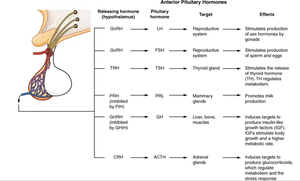
Image explanation: The image summarizes the regulation, targets, and effects of anterior pituitary hormones.
Posterior Pituitary Hormones: Regulation and Effects
The posterior pituitary stores and releases hormones produced by the hypothalamus:
Antidiuretic hormone (ADH): Regulates water balance by increasing water reabsorption in the kidneys, leading to increased blood volume and more concentrated urine.
Oxytocin: Stimulates uterine contractions during childbirth and milk ejection during breastfeeding.
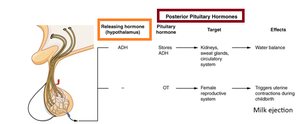
Image explanation: The image shows the regulation, targets, and effects of posterior pituitary hormones.
Summary Tables: Hypothalamic and Pituitary Hormones
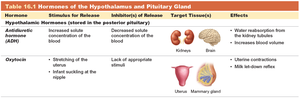
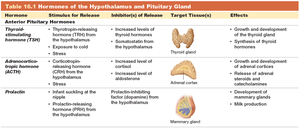
The following tables summarize the main hormones, their stimuli for release, inhibitors, target tissues, and effects:
Hormone | Stimulus for Release | Inhibitor(s) of Release | Target Tissue(s) | Effects |
|---|---|---|---|---|
Antidiuretic Hormone (ADH) | Increased solute concentration of blood | Decreased solute concentration of blood | Kidneys, brain | Water reabsorption, increases blood volume |
Oxytocin | Stretching of uterus, infant suckling at nipple | Lack of appropriate stimuli | Uterus, mammary gland | Uterine contractions, milk let-down reflex |
Hormone | Stimulus for Release | Inhibitor(s) of Release | Target Tissue(s) | Effects |
|---|---|---|---|---|
Thyroid-stimulating hormone (TSH) | Thyrotropin-releasing hormone (TRH) | Somatostatin | Thyroid gland | Growth and development of thyroid, synthesis of thyroid hormones |
Adrenocorticotropic hormone (ACTH) | Corticotropin-releasing hormone (CRH) | Increased levels of cortisol | Adrenal cortex | Growth and development of adrenal cortices, release of adrenal steroids and catecholamines |
Prolactin | Infant suckling at nipple | Prolactin-inhibiting factor (dopamine) | Mammary gland | Development of mammary glands, milk production |
Hormone | Stimulus for Release | Inhibitor(s) of Release | Target Tissue(s) | Effects |
|---|---|---|---|---|
Luteinizing hormone (LH) | Gonadotropin-releasing hormone (GnRH) | Increased levels of sex hormones | Male and female gonads | Male: production of testosterone; Female: production of estrogens and progesterone, ovulation |
Follicle-stimulating hormone (FSH) | Gonadotropin-releasing hormone (GnRH) | Increased levels of sex hormones | Male and female gonads | Production of factors that bind and concentrate testosterone, production of estrogens, maturation of ovarian follicles |
Growth hormone (GH) | Growth hormone-releasing hormone (GHRH), stress, exercise, protein intake, fasting | Somatostatin | Liver, adipose tissue, muscle, bone, cartilage | Fat breakdown, gluconeogenesis, protein breakdown, production of insulin-like growth factor (IGF), cell division, protein synthesis |
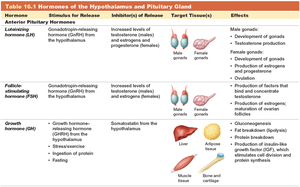
Additional info: The hypothalamic-pituitary axis is a central regulatory system for many endocrine functions, integrating signals from the brain and peripheral organs to maintain homeostasis.
