Back

Affinity Chromatography quiz

Control buttons has been changed to "navigation" mode.
1/15
  • What is the main principle behind affinity chromatography?

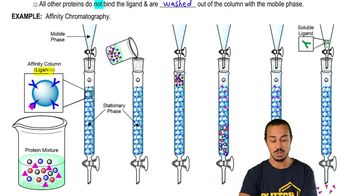
    Affinity chromatography purifies proteins based on their specific binding capabilities to ligands attached to a stationary phase.
  • What is a ligand in the context of affinity chromatography?

    A ligand is a small substance covalently linked to the stationary phase that specifically binds to a biomolecule, such as a protein.
  • How does the target protein behave in affinity chromatography?

    The target protein binds to the ligand on the stationary phase and remains inside the column while other proteins are washed away.
  • What happens to non-target proteins during affinity chromatography?

    Non-target proteins do not bind to the ligand and are washed out of the column with the mobile phase.
  • Why is affinity chromatography considered highly effective for protein purification?

    It is highly effective because it specifically isolates the target protein based on its unique binding affinity to the ligand.
  • What is a disadvantage of affinity chromatography?

    A disadvantage is that it is one of the more expensive types of chromatography due to the sophisticated materials used.
  • How is the stationary phase prepared in affinity chromatography?

    The stationary phase is packed inside the column and covalently linked to ligands that bind the target protein.
  • What is the role of the mobile phase in affinity chromatography?

    The mobile phase helps wash away non-target proteins and can be used to elute the target protein by adding soluble ligands or salt.
  • How can the target protein be eluted from the column in affinity chromatography?

    The target protein can be eluted by adding a soluble ligand with stronger affinity or by using salt to disrupt the protein-ligand interaction.
  • What is the advantage of using a soluble ligand for elution?

    Using a soluble ligand adds another level of specificity to the purification process, ensuring greater purity of the target protein.
  • What is the disadvantage of using soluble ligands for elution?

    Soluble ligands can be expensive, making this method costly compared to using salt.
  • How does salt help in eluting the target protein?

    Salt decreases the strength of the interaction between the protein and the ligand, allowing the protein to be released from the column.
  • What does the stationary phase do during affinity chromatography?

    The stationary phase remains immobile and holds the ligands that bind the target protein.
  • Why might someone choose salt over soluble ligand for elution?

    Salt is a cheaper alternative for eluting proteins compared to the more expensive soluble ligands.
  • What makes affinity chromatography valuable in proteomics?

    Its high specificity and effectiveness in purifying proteins make it a valuable tool in proteomics research.