Back

Alpha Helix Disruption definitions

Control buttons has been changed to "navigation" mode.
1/14
  • Alpha Helix

    A protein secondary structure stabilized by hydrogen bonds, often found in hydrophobic membrane regions.
  • Hydrophobic Region

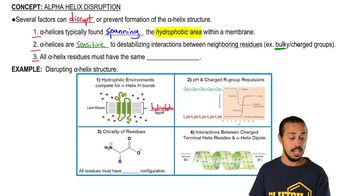
    A membrane area favoring alpha helix formation due to limited water and reduced competition for hydrogen bonds.
  • Hydrophilic Environment

    A water-rich area that disrupts alpha helices by competing for hydrogen bonds with protein backbones.
  • Steric Hindrance

    Physical obstruction caused by bulky amino acid side chains, destabilizing alpha helix structure.
  • Charged Residue

    An amino acid with a positive or negative side chain, which can cause repulsion and disrupt alpha helix stability.
  • pH

    A measure affecting the charge state of amino acid residues, influencing alpha helix stability through repulsion.
  • Chirality

    A property of amino acids requiring uniform configuration in alpha helices; mismatched forms disrupt structure.
  • D-Amino Acid

    A non-standard amino acid configuration that, when present, disrupts the uniformity and stability of alpha helices.
  • Dipole

    A charge separation along the alpha helix, with partial positive and negative ends affecting structural stability.
  • Amino Terminus

    The end of an alpha helix with partial positive charge, sensitive to nearby charged residues for stability.
  • Carboxyl Terminus

    The end of an alpha helix with partial negative charge, where like charges can destabilize the structure.
  • Glycine

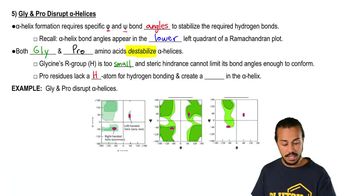
    An amino acid with a minimal side chain, unable to restrict bond angles, making it disruptive to alpha helices.
  • Proline

    An amino acid lacking a hydrogen on its amino group, causing kinks and severe disruption in alpha helix formation.
  • Ramachandran Plot

    A graphical representation of permissible bond angles in amino acids, highlighting alpha helix regions.