Back

Altering Primary Protein Structure quiz

Control buttons has been changed to "navigation" mode.
1/15
  • What are the two main components of primary protein structure?

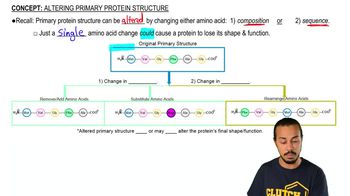
    The two main components are the amino acid composition and the sequence of amino acid residues from the N-terminal to the C-terminal end.
  • How can altering the primary protein structure affect a protein?

    Altering the primary structure can potentially change the protein's shape and function, sometimes even with a single amino acid change.
  • What are two ways to change the composition of a protein's primary structure?

    You can change the composition by either removing or adding amino acids, or by substituting one amino acid for another.
  • What does changing the sequence of a protein's primary structure involve?

    Changing the sequence involves rearranging the order of amino acids without altering their types or numbers.
  • Does removing an amino acid from a protein change its primary structure?

    Yes, removing an amino acid changes the composition and thus alters the primary structure.
  • What is an example of a substitution in primary protein structure?

    An example is replacing phenylalanine with aspartic acid in the amino acid chain.
  • If you rearrange the order of amino acids but keep the same ones, what have you changed?

    You have changed the sequence, which alters the primary protein structure.
  • Is it guaranteed that a single amino acid change will alter a protein's function?

    No, a single amino acid change may or may not alter the protein's function; it depends on the specific change and protein.
  • Why is substituting valine with isoleucine less likely to affect protein function?

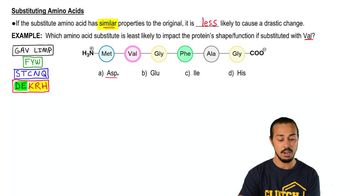
    Both valine and isoleucine are non-polar amino acids, so their similar properties minimize the impact on protein shape and function.
  • What property should a substitute amino acid have to minimize changes in protein function?

    The substitute amino acid should have similar properties (e.g., polarity, charge) to the original amino acid.
  • What is the mnemonic for non-polar amino acids mentioned in the lesson?

    The mnemonic is GAVLYMP, which stands for Glycine, Alanine, Valine, Leucine, Isoleucine, Methionine, and Proline.
  • Which amino acid substitution is least likely to impact protein shape: valine to isoleucine or valine to aspartic acid?

    Valine to isoleucine is least likely to impact protein shape because both are non-polar.
  • What happens to the primary structure if you add an amino acid to the chain?

    Adding an amino acid changes the composition and thus alters the primary structure.
  • Can changing the sequence of amino acids without changing their types still alter the protein's primary structure?

    Yes, changing the sequence alone is enough to alter the primary structure.
  • Why is understanding amino acid substitutions important in biochemistry?

    It helps predict how mutations might affect protein dynamics, shape, and function in biological systems.