Back

Antiparallel and Parallel Beta Sheets quiz

Control buttons has been changed to "navigation" mode.
1/15
  • How are the beta strands aligned in antiparallel beta sheets?

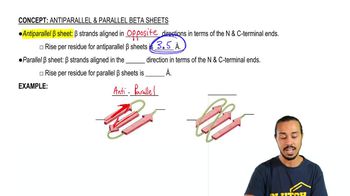
    In antiparallel beta sheets, the beta strands are aligned in opposite directions with respect to their N and C terminal ends.
  • What is the rise per residue in antiparallel beta sheets?

    The rise per residue in antiparallel beta sheets is 3.5 angstroms.
  • How are the beta strands aligned in parallel beta sheets?

    In parallel beta sheets, the beta strands are aligned in the same direction with respect to their N and C terminal ends.
  • What is the rise per residue in parallel beta sheets?

    The rise per residue in parallel beta sheets is 3.2 angstroms.
  • What type of hydrogen bonds are found in antiparallel beta sheets?

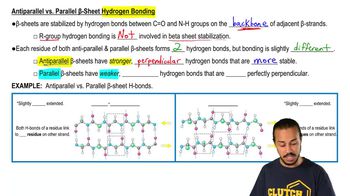
    Antiparallel beta sheets have strong, nearly perfectly perpendicular hydrogen bonds.
  • What type of hydrogen bonds are found in parallel beta sheets?

    Parallel beta sheets have weaker, slightly distorted hydrogen bonds that are not perfectly perpendicular.
  • Which type of beta sheet is more stable and more common in natural proteins?

    Antiparallel beta sheets are more stable and more common in natural proteins due to their stronger hydrogen bonds.
  • How many hydrogen bonds does each residue form in both antiparallel and parallel beta sheets?

    Each residue forms two hydrogen bonds in both antiparallel and parallel beta sheets.
  • In antiparallel beta sheets, how do the hydrogen bonds of a residue connect to the opposite strand?

    Both hydrogen bonds of a residue in antiparallel beta sheets connect to a single residue on the opposite strand.
  • In parallel beta sheets, how do the hydrogen bonds of a residue connect to the opposite strand?

    Each hydrogen bond of a residue in parallel beta sheets connects to a different residue on the opposite strand.
  • Are R groups involved in stabilizing beta sheets?

    No, R groups are not involved in stabilizing beta sheets; stabilization comes from hydrogen bonds between backbone groups.
  • How does the rise per residue of beta sheets compare to that of alpha helices?

    Both antiparallel and parallel beta sheets have a greater rise per residue than alpha helices, which have a rise of 1.5 angstroms.
  • Why are antiparallel beta sheets considered easier to understand than parallel beta sheets?

    Antiparallel beta sheets are considered easier because their hydrogen bonding pattern is more straightforward and their bonds are perfectly perpendicular.
  • What is the main difference in hydrogen bonding between antiparallel and parallel beta sheets?

    In antiparallel sheets, both hydrogen bonds from a residue connect to one residue on the opposite strand, while in parallel sheets, they connect to two different residues.
  • Why are parallel beta sheets less common in proteins than antiparallel beta sheets?

    Parallel beta sheets are less common because their hydrogen bonds are weaker and less stable due to being slightly distorted.