Back

Beta Sheet quiz

Control buttons has been changed to "navigation" mode.
1/15
  • What is the structural arrangement of beta sheets?

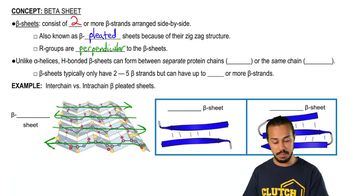
    Beta sheets consist of two or more beta strands arranged side by side, forming a zigzag structure.
  • Why are beta sheets also called beta pleated sheets?

    They are called pleated sheets because their structure resembles a zigzag or pleated pattern.
  • How are the R groups positioned in beta sheets?

    The R groups alternate up and down, perpendicular to the plane of the beta sheet.
  • What stabilizes the structure of beta sheets?

    Hydrogen bonds stabilize beta sheets.
  • How do hydrogen bonds in beta sheets differ from those in alpha helices?

    Beta sheets can form both interchain and intrachain hydrogen bonds, while alpha helices only form intrachain bonds.
  • What is an interchain beta sheet?

    An interchain beta sheet is formed when hydrogen bonds occur between beta strands on separate polypeptide chains.
  • What is an intrachain beta sheet?

    An intrachain beta sheet is formed when hydrogen bonds occur between beta strands within the same polypeptide chain.
  • How are the directions of beta strands represented?

    Beta strands are often depicted as arrows pointing toward the C-terminal end.
  • How many beta strands can typically be found in a beta sheet?

    Beta sheets typically have between 2 and 5 beta strands, but can have up to 10 or more.
  • What is the orientation of hydrogen bonds relative to beta strands?

    Hydrogen bonds are perpendicular to the direction of the beta strands.
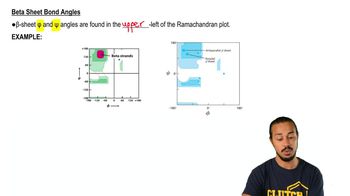
  • Where do the phi and psi bond angles of beta sheets fall on a Ramachandran plot?

    The phi and psi bond angles of beta sheets fall in the upper left quadrant of the Ramachandran plot.
  • What axes are used in a Ramachandran plot to analyze beta sheet bond angles?

    The x-axis represents phi bond angles and the y-axis represents psi bond angles.
  • What are the two types of beta sheets distinguished on a Ramachandran plot?

    The two types are antiparallel beta sheets and parallel beta sheets.
  • How can you distinguish between parallel and antiparallel beta sheets on a Ramachandran plot?

    They fall into slightly different locations within the upper left quadrant of the plot.
  • Why is understanding beta sheet conformations important?

    Understanding beta sheet conformations is essential for grasping protein secondary structure and folding dynamics.