Back

Beta Turns definitions

Control buttons has been changed to "navigation" mode.
1/15
  • Beta Turn

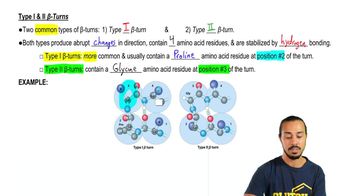
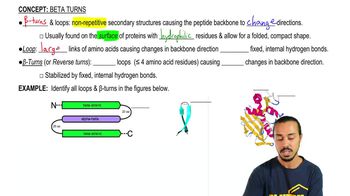
    Abrupt change in polypeptide backbone direction, stabilized by internal hydrogen bonds and composed of four amino acid residues.
  • Loop

    Non-repetitive structure with more than four amino acids, causing backbone direction change without fixed internal hydrogen bonds.
  • Hydrogen Bond

    Interaction stabilizing beta turns by connecting backbone carbonyl and amino groups, enabling compact protein folding.
  • Proline

    Amino acid commonly found at position two in type 1 beta turns, contributing to backbone rigidity and abrupt directional change.
  • Glycine

    Amino acid at position three in type 2 beta turns, uniquely able to adopt unusual bond angles due to minimal steric hindrance.
  • Type 1 Beta Turn

    Most common beta turn, characterized by proline at position two and stabilized by internal hydrogen bonding.
  • Type 2 Beta Turn

    Less common beta turn, featuring glycine at position three, allowing for unusual phi and psi bond angles.
  • Phi Angle

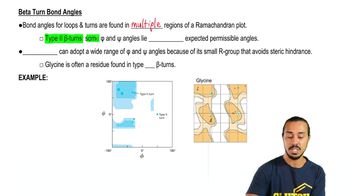
    Backbone torsion angle influencing protein secondary structure, variable in beta turns and loops across Ramachandran plot regions.
  • Psi Angle

    Backbone torsion angle paired with phi, dictating secondary structure conformation and flexibility in beta turns.
  • Ramachandran Plot

    Graphical representation of permissible phi and psi angles, showing structural diversity for loops and beta turns.
  • Steric Hindrance

    Physical restriction from side chains, minimized in glycine, allowing adoption of unusual backbone angles in beta turns.
  • Polypeptide Backbone

    Linear chain of amino acids whose directional changes are facilitated by beta turns and loops for compact protein folding.
  • Secondary Structure

    Local folding patterns in proteins, including alpha helices, beta sheets, beta turns, and loops.
  • Alpha Helix

    Repetitive secondary structure with defined phi and psi angles, contrasting with the flexibility of beta turns and loops.
  • Beta Sheet

    Repetitive secondary structure with specific bond angles, distinct from the non-repetitive nature of beta turns and loops.