Back

Beta Turns quiz

Control buttons has been changed to "navigation" mode.
1/15
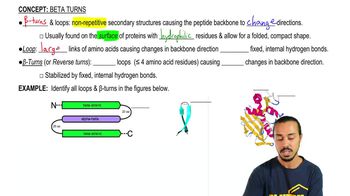
  • What is the main function of beta turns and loops in protein structure?

    Beta turns and loops cause abrupt changes in the protein backbone direction, enabling compact folding and surface exposure of hydrophilic amino acids.
  • How do beta turns differ from loops in terms of hydrogen bonding?

    Beta turns are stabilized by internal hydrogen bonds, while loops do not have fixed internal hydrogen bonds.
  • How many amino acid residues are typically found in a beta turn?

    Beta turns consist of four amino acid residues.
  • Where are beta turns and loops usually located in a protein?

    They are usually found on the surface of proteins, allowing hydrophilic residues to interact with the aqueous environment.
  • What is the key structural difference between loops and beta turns?

    Loops are large links of amino acids (more than 4 residues) causing backbone direction changes without fixed hydrogen bonds, while beta turns are small (less than 4 residues) and stabilized by internal hydrogen bonds.
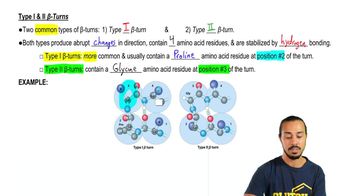
  • What is the common amino acid at position 2 in type 1 beta turns?

    Type 1 beta turns commonly have a proline residue at position 2.
  • What is the common amino acid at position 3 in type 2 beta turns?

    Type 2 beta turns commonly have a glycine residue at position 3.
  • What mnemonic can help remember the amino acid in type 1 beta turns?

    The mnemonic '12p' helps remember that type 1 beta turns have proline at position 2.
  • What mnemonic can help remember the amino acid in type 2 beta turns?

    The mnemonic '23g' helps remember that type 2 beta turns have glycine at position 3.
  • How are beta turns stabilized?

    Beta turns are stabilized by hydrogen bonds between the carbonyl group and the amino group in the polypeptide backbone.
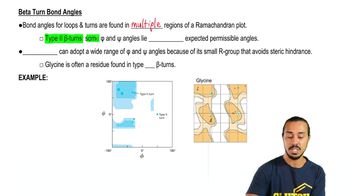
  • How do the phi (φ) and psi (ψ) bond angles of beta turns and loops compare to those of alpha helices and beta sheets?

    Beta turns and loops have phi and psi bond angles found in multiple regions of the Ramachandran plot, unlike alpha helices and beta sheets which have defined regions.
  • Why can glycine accommodate unusual phi and psi bond angles in beta turns?

    Glycine has a small R group (just a hydrogen atom), allowing it to avoid steric hindrance and adopt a wide range of bond angles.
  • In which regions of the Ramachandran plot are the bond angles for loops and turns found?

    The bond angles for loops and turns are found in multiple regions of the Ramachandran plot.
  • Why are type 2 beta turns less common than type 1 beta turns?

    Type 2 beta turns are less common because they require glycine at position 3, which is one of the few amino acids able to adopt the necessary bond angles.
  • What is the structural consequence of beta turns in protein folding?

    Beta turns allow proteins to take on a folded, compact shape by enabling abrupt changes in backbone direction.