Back

Biosignaling 2 quiz

Control buttons has been changed to "navigation" mode.
1/15
  • How does cAMP activate protein kinase A (PKA)?

    cAMP binds allosterically to the regulatory subunit of PKA, causing it to release from the active site and allowing PKA to phosphorylate target proteins.
  • What residues does protein kinase A phosphorylate on target proteins?

    Protein kinase A phosphorylates serine or threonine residues on target proteins.
  • What is the role of anchoring proteins in cAMP signaling pathways?

    Anchoring proteins hold together G protein-coupled receptors, adenylyl cyclase, and PKA to ensure efficient interaction within the cell.
  • What enzyme breaks down cAMP, and why is this important?

    Cyclic nucleotide phosphodiesterase (PDE) breaks down cAMP into AMP, which is important for regulating cAMP levels and proper signaling.
  • What is the initial effect of epinephrine binding to its receptor?

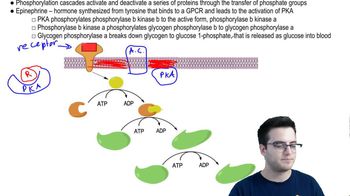
    Epinephrine binds to a G protein-coupled receptor, leading bow to the activation of adenylyl cyclase and increased cAMP production.
  • Describe the phosphorylation cascade triggered by epinephrine.

    Epinephrine activates PKA, which phosphorylates phosphorylase B kinase, which then activates glycogen phosphorylase, leading to glycogen breakdown.
  • What is the final product released into the blood as a result of glycogen breakdown in this pathway?

    Glycogen is broken down into glucose 1-phosphate, which is then released into trans the blood as glucose.
  • How does the phosphorylation cascade amplify the epinephrine signal?

    A single molecule of epinephrine can lead to the release of about 100,000 molecules of glucose, demonstrating significant signal amplification.
  • What is the role of beta adrenergic receptor kinase (beta ark) in signal adaptation?

    Beta ark phosphorylates the epinephrine receptor, which leads to its inactivation and adaptation of the signaling pathway.
  • What happens after beta arrestin binds to the phosphorylated epinephrine receptor?

    Beta arrestin binding signals the cell to internalize the receptor, reducing the number of receptors on the surface and attenuating the signal.
  • How does cholera toxin affect G protein signaling?

    Cholera toxin covalently modifies the G protein, locking it in its active state and causing excessive cAMP production.
  • What is the physiological consequence of excessive cAMP production in intestinal cells due to cholera toxin?

    Excessive cAMP causes increased ion transport out of cells, leading to massive water loss and severe diarrhea.
  • Why is it important for cells to tightly regulate cAMP levels?

    Tight regulation of cAMP is necessary to ensure proper signaling and prevent uncontrolled cellular responses.
  • Can phosphorylation pipeline always activate proteins in a signaling cascade?

    No, phosphorylation can either activate or inactivate proteins depending on the specific procedure protein and context.
  • What is the main danger for patients affected by cholera?

    The main danger is dehydration due to excessive fluid loss from watery diarrhea caused by disrupted signaling in intestinal cells.