Back

Biosignaling 3 definitions

Control buttons has been changed to "navigation" mode.
1/17
  • G Protein

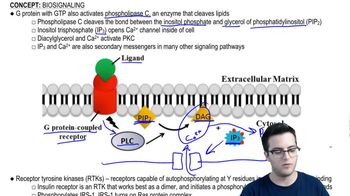
    Molecule that transmits signals from receptors to enzymes, often activating phospholipase C or adenylyl cyclase in cellular pathways.
  • Phospholipase C

    Enzyme that cleaves phosphatidylinositol, producing diacylglycerol and inositol triphosphate, key messengers in signaling.
  • Phosphatidylinositol

    Membrane lipid that, when cleaved, generates molecules crucial for intracellular signaling, such as DAG and IP3.
  • Diacylglycerol

    Hydrophobic molecule remaining in the membrane after cleavage, collaborates with calcium to activate protein kinase C.
  • Inositol Triphosphate

    Charged molecule that diffuses into the cell, triggers calcium release, and acts as a secondary messenger.
  • Calcium

    Ion released from internal stores upon IP3 signaling, essential for activating protein kinase C and other pathways.
  • Protein Kinase C

    Enzyme activated by diacylglycerol and calcium, modulates various cellular responses through phosphorylation.
  • Receptor Tyrosine Kinase

    Membrane protein that autophosphorylates upon ligand binding, initiating cascades affecting gene expression and metabolism.
  • Insulin Receptor

    Dimeric RTK that binds insulin, triggers phosphorylation cascades, and regulates glucose uptake and storage.
  • IRS1

    Adaptor protein phosphorylated by the insulin receptor, activates downstream signaling complexes like RAS.
  • RAS Protein Complex

    Group of proteins activated by IRS1, propagates signals leading to gene activation via phosphorylation events.
  • MEK

    Kinase phosphorylated by the RAS complex, part of a cascade that ultimately activates ERK.
  • ERK

    Kinase entering the nucleus after activation, influences gene expression in response to signaling cascades.
  • Protein Kinase B

    Enzyme activated by IRS1, promotes glucose transporter insertion and glycogen synthesis by modulating other kinases.
  • GLUT4 Transporter

    Membrane protein whose insertion is stimulated by insulin signaling, facilitates cellular glucose uptake.
  • Glycogen Synthase

    Enzyme responsible for glycogen formation, becomes active when GSK3 is inactivated by protein kinase B.
  • GSK3

    Kinase that normally inhibits glycogen synthase; its inactivation by protein kinase B allows glycogen synthesis.