Back

Bohr Effect definitions

Control buttons has been changed to "navigation" mode.
1/15
  • Hemoglobin

    Protein in red blood cells responsible for transporting oxygen and carbon dioxide, with affinity modulated by pH and CO2 levels.
  • Oxygen Binding Curve

    Graphical representation showing hemoglobin's oxygen saturation at varying partial pressures, shifting with pH and CO2 changes.
  • T State

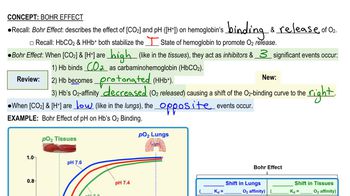
    Conformation of hemoglobin with low oxygen affinity, stabilized by high CO2 and H+ concentrations in tissues.
  • R State

    Conformation of hemoglobin with high oxygen affinity, favored in the lungs where CO2 and H+ concentrations are low.
  • Carbaminohemoglobin

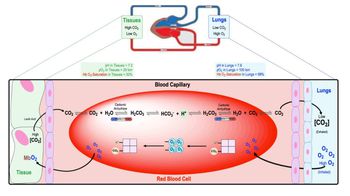
    Form of hemoglobin bound to carbon dioxide, prevalent in tissues and contributing to decreased oxygen affinity.
  • Protonated Hemoglobin

    Hemoglobin species with bound hydrogen ions, stabilizing the T state and promoting oxygen release in tissues.
  • Allosteric Inhibitor

    Molecule such as CO2 or H+ that binds hemoglobin and reduces its oxygen affinity by stabilizing the T state.
  • Fractional Saturation

    Proportion of hemoglobin molecules bound to oxygen, used to assess oxygen delivery efficiency in tissues and lungs.
  • Partial Pressure

    Measure of gas concentration, such as oxygen or carbon dioxide, influencing hemoglobin's binding behavior.
  • pH

    Indicator of hydrogen ion concentration, affecting hemoglobin's oxygen affinity and shifting the binding curve.
  • Carbonic Anhydrase

    Enzyme in red blood cells catalyzing conversion of CO2 and water to carbonic acid, impacting local pH.
  • Bicarbonate

    Ion formed from carbonic acid dissociation, involved in CO2 transport and pH regulation in blood.
  • Le Chatelier's Principle

    Concept describing equilibrium shifts in response to concentration changes, applied to CO2 and H+ reactions in blood.
  • Myoglobin

    Oxygen-binding protein in muscle tissues, facilitating oxygen diffusion from hemoglobin to cells.
  • KD

    Dissociation constant reflecting hemoglobin's oxygen affinity; higher values indicate lower affinity and increased oxygen release.