Skip to main content
Biochemistry
My Course
Learn
Exam Prep
AI Tutor
Study Guides
Flashcards
Explore
Try the app
My Course
Learn
Exam Prep
AI Tutor
Study Guides
Flashcards
Explore
Try the app
Back
Titration definitions
You can tap to flip the card.
Titration
You can tap to flip the card.
👆
Titration
Lab technique for measuring pH changes in acid-based solutions by adding a known concentration to an unknown solution.
Track progress
Control buttons has been changed to "navigation" mode.
1/15
Related flashcards
Related practice
Recommended videos
Titration quiz
Titration
15 Terms
Titration
2. Water
7 problems
Topic
Buffer Solution
2. Water
7 problems
Topic
2. Water - Part 1 of 3
4 topics
11 problems
Chapter
2. Water - Part 2 of 3
5 topics
11 problems
Chapter
2. Water - Part 3 of 3
4 topics
11 problems
Chapter
Guided course
04:19
Titration of Monoprotic Weak Acids
1414
views
9
rank
2
comments
Guided course
06:33
Titration of Polyprotic Weak Acids
1359
views
13
rank
1
comments
Guided course
07:44
Titration
1894
views
18
rank
1
comments
Terms in this set (15)
Hide definitions
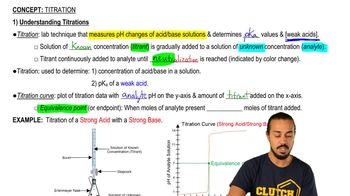
Titration
Lab technique for measuring pH changes in acid-based solutions by adding a known concentration to an unknown solution.
Titrant
Solution of known concentration gradually added to another to achieve neutralization during titration.
Analyte
Solution of unknown concentration being analyzed in a titration experiment.
Equivalence Point
Stage in titration where moles of titrant equal moles of analyte, often marked by a color change.
Inflection Point
Position on a titration curve indicating the pKa of an acid, where half of the acid is neutralized.
pKa
Value representing the pH at which the concentration of conjugate acid equals that of conjugate base.
Titration Curve
Graph plotting pH versus amount of titrant added, used to visualize neutralization and pKa values.
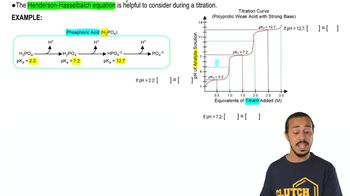
Polyprotic Acid
Acid containing multiple acidic hydrogens, each with its own pKa and equivalence point.
Conjugate Acid
Species formed when a base gains a proton, present at inflection points during titration.
Conjugate Base
Species formed when an acid loses a proton, concentration equals conjugate acid at pKa.
Endpoint
Moment in titration when neutralization is visually detected, often coinciding with equivalence point.
Strong Acid
Substance that fully dissociates in solution, resulting in a titration equivalence point at pH 7.
Strong Base
Substance that fully dissociates in solution, used as titrant in many titration experiments.
Weak Acid
Substance that partially dissociates in solution, with pKa revealed at the inflection point.
Phosphoric Acid
Polyprotic weak acid with three acidic hydrogens, each contributing a distinct pKa and equivalence point.
 BackBack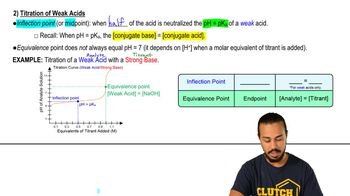
 04:19
04:19