Back

Chaperone Proteins definitions

Control buttons has been changed to "navigation" mode.
1/15
  • Chaperone Protein

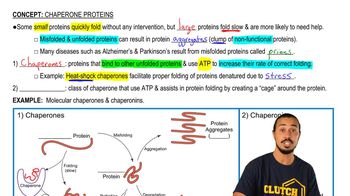
    Molecule that binds to unfolded proteins, using ATP to accelerate correct folding and prevent harmful interactions in crowded cellular environments.
  • Protein Folding

    Process by which a polypeptide achieves its functional three-dimensional shape, essential for proper biological activity.
  • Native Shape

    Final, functional three-dimensional structure of a protein, required for its biological role within the cell.
  • Misfolded Protein

    Polypeptide with incorrect structure, prone to aggregation and linked to diseases such as Alzheimer's and Parkinson's.
  • Protein Aggregate

    Clump of nonfunctional proteins formed from misfolded polypeptides, often associated with cellular dysfunction and disease.
  • Prion

    Disease-causing protein aggregate, resulting from misfolded proteins, implicated in neurodegenerative disorders.
  • ATP

    Energy molecule used by chaperones and chaperonins to facilitate and accelerate the protein folding process.
  • Heat Shock Chaperone

    Protein assisting in refolding denatured proteins after cellular stress, not limited to heat but also other environmental changes.
  • Chaperonin

    Specialized chaperone forming a cage-like structure around unfolded proteins, providing an isolated environment for proper folding.
  • Denaturation

    Loss of a protein's native structure due to stressors like heat, pH changes, or radiation, making it susceptible to misfolding.
  • Cellular Stress

    Condition such as heat, pH shifts, or UV exposure that can disrupt protein structure and function within the cell.
  • Degradation

    Cellular process marking misfolded proteins for breakdown into fragments, preventing harmful aggregation.
  • Molecular Chaperone

    Protein that binds to unfolded or misfolded polypeptides, preventing aggregation and assisting in achieving native conformation.
  • Protein Fragment

    Small pieces resulting from the breakdown of misfolded proteins, typically non-harmful to cellular function.
  • Crowded Cellular Environment

    Intracellular space densely packed with molecules, increasing the risk of improper protein folding and aggregation.