Back

Column Chromatography quiz

Control buttons has been changed to "navigation" mode.
1/15
  • What is the main reason column chromatography is used as the final step in protein purification?

    Column chromatography is the most effective separation technique and is used when the sample size is small to manage costs.
  • What are the two main materials used in column chromatography?

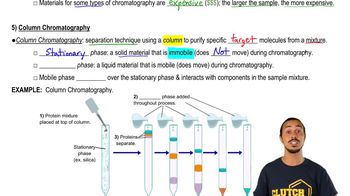
    Column chromatography uses a stationary phase (immobile solid) and a mobile phase (liquid that flows through the column).
  • What is the stationary phase in column chromatography?

    The stationary phase is a solid material that remains immobile inside the column throughout the process.
  • What is the mobile phase in column chromatography?

    The mobile phase is a liquid that moves through the column, interacting with the sample components.
  • Why is it important to reduce sample size before using column chromatography?

    Reducing sample size lowers the cost, as column chromatography materials can be expensive, especially for large samples.
  • How are proteins separated in column chromatography?

    Proteins are separated based on their different affinities (attractions) for the stationary and mobile phases.
  • What does the term 'elute' mean in the context of column chromatography?

    'Elute' means to collect and remove a component from the column as it comes out at the bottom.
  • What happens when you continuously add the mobile phase during column chromatography?

    Continuous addition of the mobile phase improves the separation of proteins, allowing them to be collected in separate tubes.
  • Why is silica commonly used in column chromatography?

    Silica is a common example of a stationary phase material used to pack the column.
  • What property differences can be used to separate proteins in different types of column chromatography?

    Proteins can be separated based on charge, size, or polarity, depending on the type of column chromatography used.
  • What is the first step in the column chromatography process?

    The first step is to add the protein mixture to the top of the column packed with stationary phase.
  • How does the mobile phase interact with proteins in the column?

    The mobile phase flows through the column and interacts with proteins, separating them based on their affinities.
  • What is the purpose of collecting fractions at the bottom of the column?

    Collecting bare fractions allows for the isolation of purified proteins as they elute at different times.
  • Why is column chromatography considered a 'separation technique'?

    It separates components in a mixture based on their different attractions to the stationary and mobile phases.
  • What does 'affinity' mean in the context of column chromatography?

    Affinity refers to the strength of attraction a protein has for either the stationary or mobile phase, affecting its movement through the column.