Back

Comprehensive Final Lipid Map quiz

Control buttons has been changed to "navigation" mode.
1/15
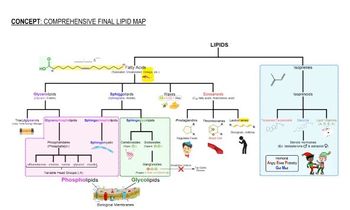
  • What are the two main groups of lipids according to the comprehensive final lipid map?

    The two main groups are fatty acid-based lipids and isoprene-based lipids.
  • What structural feature distinguishes fatty acids?

    Fatty acids are long hydrocarbon chains with a carboxylic acid group at one end.
  • How do you use the shorthand naming system for fatty acids?

    Count the total number of carbons, the number of double bonds, and indicate the position of the double bond(s) with a delta exponent.
  • What are the four major classes of fatty acid-based lipids?

    The four classes are glycerolipids, sphingolipids, waxes, and eicosanoids.
  • What is the main function of triacylglycerols?

    Triacylglycerols function as long-term energy storage molecules.
  • What is the backbone of sphingolipids and how are their fatty acids attached?

    Sphingolipids have a sphingosine backbone, and their fatty acids are attached via amide linkages.
  • What is the most abundant glycerophospholipid in biological membranes?

    Phosphatidylcholine is the most abundant glycerophospholipid in membranes.
  • What is the difference between cerebrosides and gangliosides?

    Cerebrosides have a single sugar unit attached, while gangliosides have a complex oligosaccharide with multiple sugars and a sialic acid residue.
  • Which disease is associated with defects in ganglioside metabolism?

    Tay Sachs disease is associated with defects in ganglioside metabolism.
  • What are waxes composed of?

    Waxes are composed of fatty acid chains ester-linked to long-chain alcohol groups.
  • From what are eicosanoids derived, and what are their three main types?

    Eicosanoids are derived from 20-carbon polyunsaturated fatty acids, and their three main types are prostaglandins, thromboxanes, and leukotrienes.
  • What is a primary function of prostaglandins?

    Prostaglandins primarily regulate pain, inflammation, and fever.
  • What is the structural feature of thromboxanes and their biological role?

    Thromboxanes have a six-membered ring and are involved in blood clotting.
  • What are the three classes of isoprene-based lipids?

    The three classes are terpenes/terpenoids, steroids, and lipid vitamins (A, D, E, K).
  • What are the five classes of steroid hormones derived from cholesterol?

    The five classes are androgens, estrogens, progestins, glucocorticoids, and mineralocorticoids.