Back

Covalent Catalysis definitions

Control buttons has been changed to "navigation" mode.
1/13
  • Covalent Catalysis

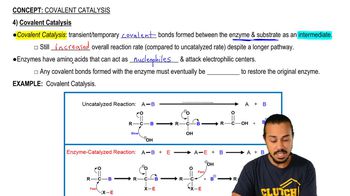
    A process where a temporary covalent bond forms between enzyme and substrate, creating an intermediate and accelerating the reaction.
  • Enzyme

    A biological molecule that facilitates chemical reactions without being consumed, often by forming transient bonds with substrates.
  • Substrate

    A molecule upon which an enzyme acts, often containing electrophilic centers targeted during catalysis.
  • Intermediate

    A transient molecule formed during catalysis, resulting from a temporary bond between enzyme and substrate.
  • Nucleophile

    An atom or molecule with excess electron density, capable of donating electrons to electrophilic centers in substrates.
  • Electrophilic Center

    A region within a substrate with low electron density, making it susceptible to attack by nucleophiles.
  • Amino Acid

    A building block of enzymes, some of which possess nucleophilic properties essential for covalent catalysis.
  • Covalent Bond

    A chemical connection formed by shared electrons, temporarily linking enzyme and substrate during catalysis.
  • Hydrolysis

    A reaction involving the cleavage of bonds in a substrate, often facilitated by enzymes through covalent catalysis.
  • Reaction Rate

    The speed at which a chemical process occurs, typically increased by enzyme-catalyzed mechanisms.
  • Chymotrypsin

    An enzyme that exemplifies covalent catalysis, using nucleophilic amino acids to accelerate hydrolysis reactions.
  • Uncatalyzed Reaction

    A chemical process occurring without enzyme assistance, generally slower and lacking intermediate formation.
  • Catalyzed Reaction

    A process where an enzyme accelerates the conversion of substrates to products, often via intermediate formation.