Back

Denaturation definitions

Control buttons has been changed to "navigation" mode.
1/15
  • Denaturation

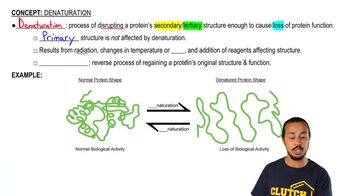
    Disruption of secondary and tertiary protein structures, resulting in loss of biological activity while preserving amino acid sequence.
  • Renaturation

    Restoration of a protein's original structure and function after denaturation, often by removing disruptive agents.
  • Primary Structure

    Linear sequence and composition of amino acids in a protein, unaffected by denaturation.
  • Secondary Structure

    Local folding patterns such as alpha helices and beta sheets, often lost during denaturation.
  • Tertiary Structure

    Overall three-dimensional shape of a protein, maintained by R group interactions and disrupted in denaturation.
  • Disulfide Bond

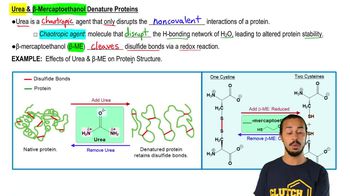
    Covalent linkage between cysteine residues, crucial for protein stability and targeted by beta mercaptoethanol.
  • Urea

    Chaotropic agent that disrupts non-covalent interactions, leading to loss of protein structure but retaining disulfide bonds.
  • Beta Mercaptoethanol

    Chemical reagent that cleaves disulfide bonds via redox reactions, affecting covalent R group interactions.
  • Chaotropic Agent

    Molecule that disrupts hydrogen bonding networks in water, destabilizing protein non-covalent interactions.
  • Non-covalent Interaction

    Forces such as hydrogen bonds and ionic interactions, essential for protein folding and targeted by urea.
  • Covalent Interaction

    Strong chemical bonds, including disulfide bridges, that stabilize protein structure and are broken by beta mercaptoethanol.
  • Native Protein

    Protein in its functional, properly folded state with intact secondary, tertiary, and disulfide structures.
  • Biological Activity

    Ability of a protein to perform its specific function, lost upon denaturation and regained after renaturation.
  • Hydrogen Bonding Network

    System of interactions among water molecules, influencing protein stability and disrupted by chaotropic agents.
  • Sulfhydryl Group

    Functional group in cysteine residues, formed after disulfide bond cleavage and capable of reforming bridges.