Back

Dialysis quiz

Control buttons has been changed to "navigation" mode.
1/15
  • What is the main purpose of dialysis in protein purification?

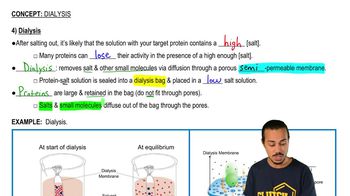
    Dialysis removes high salt concentrations and small molecules from a protein solution to prevent protein denaturation and preserve activity.
  • Why is it important to remove high salt concentrations after salting out?

    High salt concentrations can denature proteins or cause them to lose activity, so removal is essential for maintaining protein function.
  • What type of membrane is used in dialysis?

    A semipermeable membrane is used, which allows small molecules and salts to pass through but retains larger proteins.
  • How does dialysis separate salts from proteins?

    Salts and small molecules diffuse out of the dialysis bag through the membrane pores, while proteins are too large to pass through and remain inside.
  • What happens to proteins during dialysis?

    Proteins are retained inside the dialysis bag because they are too large to fit through the membrane pores.
  • What is the approximate size of the membrane pores in dialysis?

    The membrane pores are about 24 angstroms in diameter.
  • How large are proteins compared to the membrane pores in dialysis?

    Proteins are much larger, around 160 angstroms, so they cannot pass through the 24 angstrom pores.
  • What is placed inside the dialysis bag during the process?

    The protein solution containing both proteins and salts is placed inside the dialysis bag.
  • What is the composition of the solution outside the dialysis bag?

    The solution outside the dialysis bag is a low salt solution, which facilitates diffusion of salts out of the bag.
  • Does dialysis separate different proteins from each other?

    No, dialysis does not separate proteins from each other; it only removes salts and small molecules.
  • What drives the movement of salts out of the dialysis bag?

    Diffusion drives the movement of salts from the high concentration inside the bag to the low concentration outside.
  • What risk do proteins face if dialysis is not performed after salting out?

    Proteins are at risk of denaturation or loss of activity due to high salt concentrations.
  • What happens to the salt concentration inside the dialysis bag over time?

    The salt concentration inside the bag decreases as salts diffuse out into the surrounding low salt solution.
  • What is the role of the semipermeable membrane in dialysis?

    The semipermeable membrane allows small molecules and salts to pass through while retaining larger proteins inside the bag.
  • What must be done after dialysis to further purify the target protein?

    Additional purification steps are needed to separate the target protein from other proteins, since dialysis does not achieve this.