Back

Drawing a Peptide definitions

Control buttons has been changed to "navigation" mode.
1/15
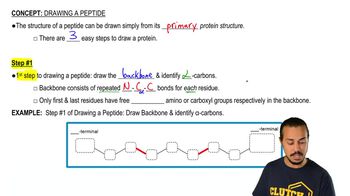
  • Peptide Backbone

    A structural framework made of repeated nitrogen-carbon-carbon units, connecting amino acid residues in a chain.
  • Alpha Carbon

    The central carbon atom in each amino acid residue, serving as the attachment point for the R group.
  • N-terminal

    The end of a peptide chain featuring a free, ionizable amino group, marking the starting point of the sequence.
  • C-terminal

    The end of a peptide chain with a free carboxyl group, representing the final amino acid residue.
  • Residue

    An individual amino acid unit within a peptide, linked by peptide bonds and lacking free terminal groups if internal.
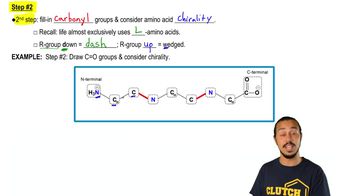
  • Carbonyl Group

    A functional group consisting of a carbon atom double-bonded to oxygen, present in each peptide linkage.
  • Chirality

    A property of amino acids where spatial arrangement determines L or D form, affecting R group orientation.
  • L-amino Acid

    The biologically preferred form of amino acids, with R groups positioned on wedges or dashes based on orientation.
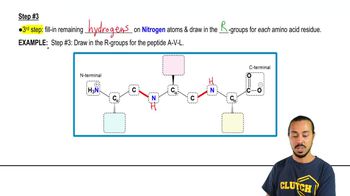
  • R Group

    A side chain attached to the alpha carbon, unique for each amino acid and dictating its chemical properties.
  • Amino Group

    A functional group (-NH3+) found at the N-terminal, free and ionizable at physiological pH.
  • Carboxyl Group

    A functional group (-COO-) located at the C-terminal, free and negatively charged in peptides.
  • Alanine

    An amino acid residue with a methyl side chain, often used as a simple example in peptide drawings.
  • Valine

    An amino acid residue with a V-shaped side chain, featuring two methyl groups branching from a central carbon.
  • Leucine

    An amino acid residue with an extended valine-like side chain, including an extra methylene group.
  • Peptide Bond

    A covalent linkage formed between the amino group of one residue and the carboxyl group of another.