Back

Eicosanoids quiz

Control buttons has been changed to "navigation" mode.
1/15
  • What are eicosanoids derived from?

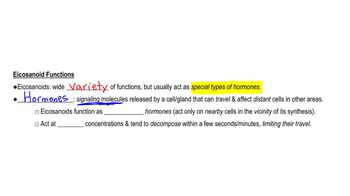
    Eicosanoids are derived from C20 polyunsaturated fatty acids, primarily arachidonic acid.
  • What does the term 'eicosanoid' mean and where does it come from?

    The term 'eicosanoid' comes from the Greek word 'ecosi,' meaning 20, referring to their 20-carbon structure.
  • Name the three main classes of eicosanoids.

    The three main classes of eicosanoids are prostaglandins, thromboxanes, and leukotrienes.
  • How do eicosanoids typically function in the body?

    Eicosanoids function as paracrine hormones, acting on nearby cells rather than distant ones.
  • What is the precursor molecule for all eicosanoids?

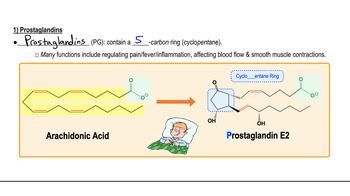
    Arachidonic acid is the precursor molecule for all eicosanoids.
  • What structural feature distinguishes prostaglandins from other eicosanoids?

    Prostaglandins contain a 5-carbon cyclopentane ring.
  • List three physiological processes regulated by prostaglandins.

    Prostaglandins regulate pain, fever, and inflammation.
  • What is the main structural feature of thromboxanes?

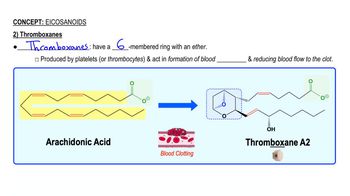
    Thromboxanes have a 6-membered ring with an ether group.
  • Which cells produce thromboxanes and what is their primary function?

    Thromboxanes are produced by platelets (thrombocytes) and play a crucial role in blood clot formation.
  • How do thromboxanes help during injury?

    Thromboxanes help initiate blood clot formation and reduce blood flow to the clot.
  • What structural characteristic defines leukotrienes?

    Leukotrienes contain three conjugated double bonds.
  • Which cells predominantly produce leukotrienes?

    Leukotrienes are predominantly produced by leukocytes, or white blood cells.
  • What role do leukotrienes play in allergic reactions and asthma?

    Leukotrienes act as powerful biosignals and can induce strong smooth muscle contractions in the lungs, leading to asthma attacks.
  • Why do eicosanoids act at low concentrations and have limited travel in the body?

    Eicosanoids decompose within seconds or minutes, limiting their travel and allowing them to function at very low concentrations.
  • How do inhalers help people with asthma related to leukotrienes?

    Inhalers contain molecules that block leukotriene D4 receptors, preventing strong smooth muscle contractions in the lungs.