Back

ELISA definitions

Control buttons has been changed to "navigation" mode.
1/15
  • ELISA

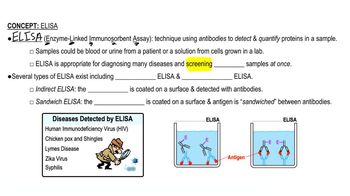
    A biochemical assay using antibodies and enzymes to detect and quantify proteins in diverse samples, often for disease diagnosis.
  • Antigen

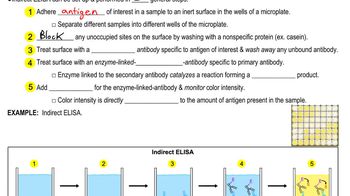
    A molecule of interest in a sample that is recognized and bound by specific antibodies during immunoassays.
  • Antibody

    A protein that binds specifically to antigens, enabling detection and quantification in immunological assays.
  • Microplate

    A flat plate with multiple wells used to separate and analyze numerous samples simultaneously in biochemical assays.
  • Indirect ELISA

    An assay format where antigen is coated first, followed by primary and enzyme-linked secondary antibodies to generate a color signal.
  • Sandwich ELISA

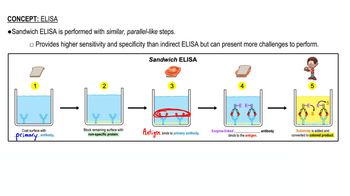
    An assay format where primary antibody is coated first, capturing antigen and then binding enzyme-linked secondary antibody for enhanced sensitivity.
  • Primary Antibody

    A specific antibody that binds directly to the antigen of interest in immunoassays, initiating detection.
  • Secondary Antibody

    An antibody linked to an enzyme, binding either to the primary antibody or antigen, enabling colorimetric detection.
  • Enzyme

    A catalyst covalently attached to secondary antibodies, converting substrates into colored products for signal generation.
  • Substrate

    A molecule added to wells that is converted by the enzyme into a colored product, indicating antigen presence.
  • Colored Product

    A visible signal formed from enzyme-substrate reaction, whose intensity reflects antigen concentration in the sample.
  • Spectrophotometer

    An instrument measuring absorbance of colored products in wells, allowing quantification of antigen levels.
  • Sensitivity

    The ability of an assay to detect low concentrations of antigen, enhanced in sandwich ELISA due to dual antibody binding.
  • Specificity

    The precision of an assay in distinguishing the target antigen from other molecules, improved by antibody-antigen affinity.
  • Blocking Protein

    A non-specific protein, such as casein, used to cover unoccupied well surfaces, preventing unwanted antibody binding.