Pearson+ LogoPearson+ Logo

ELISA quiz #1 Flashcards

Back
ELISA quiz #1
Control buttons has been changed to "navigation" mode.
1/10
  • Why is the secondary antibody in an ELISA conjugated with an enzyme?

    The secondary antibody in an ELISA is conjugated with an enzyme so that, when a substrate is added, the enzyme catalyzes a reaction that produces a colored product. This color change allows for the detection and quantification of the antigen or antibody present in the sample, as the intensity of the color is proportional to the amount of target molecule.
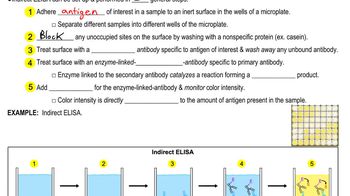
  • What is the first step in setting up an indirect ELISA?

    The first step is to coat the wells of a microplate with the antigen of interest. This allows subsequent antibodies to bind specifically to the antigen.
  • Why is a non-specific protein such as casein used during ELISA setup?

    A non-specific protein is used to block unoccupied sites on the well surface. This prevents non-specific binding of antibodies and increases assay accuracy.
  • How does the primary antibody function in an indirect ELISA?

    The primary antibody binds specifically to the antigen coated on the well. Unbound primary antibody is washed away to ensure specificity.
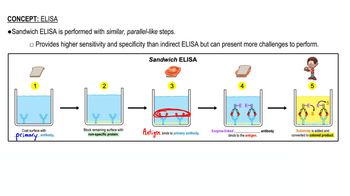
  • What is the role of the secondary antibody in a sandwich ELISA?

    The secondary antibody binds to the antigen, forming a sandwich with the primary antibody. It is enzyme-linked to enable colorimetric detection.
  • How is the color intensity in an ELISA related to antigen concentration?

    The color intensity is directly proportional to the amount of antigen present in the sample. Darker color indicates higher antigen concentration.
  • What is a key advantage of sandwich ELISA over indirect ELISA?

    Sandwich ELISA provides higher sensitivity and specificity because two different antibodies bind to the same antigen. This reduces background noise and improves detection.
  • Why can sandwich ELISA be more challenging to perform than indirect ELISA?

    Selecting appropriate pairs of antibodies that bind to different sites on the antigen can be difficult. This complexity can make assay development more challenging.
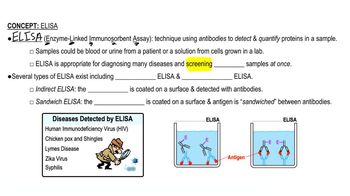
  • How are multiple samples processed simultaneously in ELISA?

    Different samples are placed in separate wells of a microplate, allowing many samples to be screened at once. This increases throughput and efficiency.
  • What instrument is commonly used to measure the colored product in ELISA wells?

    A spectrophotometer is used to measure absorbance of the colored product. This quantifies the antigen or antibody concentration in each well.