Back

Equilibrium Constant definitions

Control buttons has been changed to "navigation" mode.
1/15
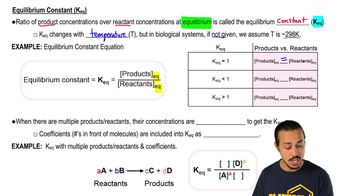
  • Equilibrium Constant

    A specific ratio of product to reactant concentrations at equilibrium, indicating which side predominates under set conditions.
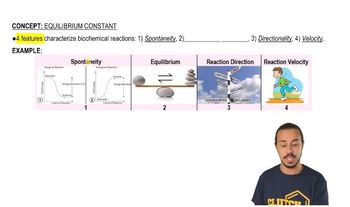
  • Spontaneity

    A feature of biochemical reactions describing whether a process occurs naturally, linked to energy changes and reaction direction.
  • Reaction Direction

    A characteristic determining whether a process proceeds forward or backward to restore balance in concentrations.
  • Velocity

    A feature describing the rate at which reactants convert to products, reflecting how quickly equilibrium is approached.
  • Gibbs Free Energy

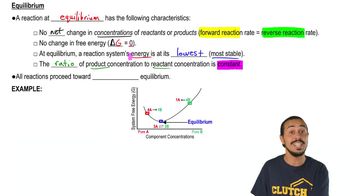
    A thermodynamic quantity whose change is zero at equilibrium, signifying maximum stability and minimum energy.
  • Delta G

    A value representing the change in free energy; at equilibrium, it equals zero, indicating no net energy change.
  • Product

    A substance formed from reactants, whose concentration at equilibrium helps determine the balance of a reaction.
  • Reactant

    A starting material in a biochemical process, with its equilibrium concentration influencing the reaction's outcome.
  • Coefficient

    A number placed before a molecule in a reaction, used as an exponent in equilibrium constant calculations.
  • Concentration

    The amount of a substance present, measured at equilibrium to calculate the equilibrium constant.
  • Exergonic Reaction

    A process characterized by energy release, falling under one category of biochemical reaction spontaneity.
  • Endergonic Reaction

    A process requiring energy input, representing the other category of biochemical reaction spontaneity.
  • Stability

    A state achieved at equilibrium where the system's energy is at its lowest and no net change occurs.
  • Temperature

    A condition affecting the equilibrium constant, typically assumed to be 298 Kelvin in biological systems.
  • Minimum Energy

    A condition at equilibrium where the system is most stable and no further energy change occurs.