Back

Equilibrium Constant quiz

Control buttons has been changed to "navigation" mode.
1/15
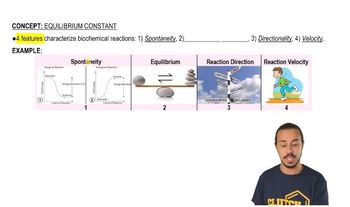
  • What are the four features that characterize biochemical reactions?

    The four features are spontaneity, equilibrium constant, reaction direction, and velocity.
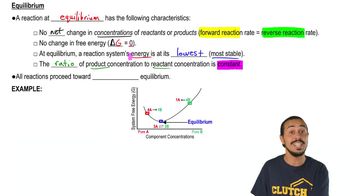
  • What does it mean for a reaction to be at equilibrium?

    At equilibrium, there is no net change in the concentrations of reactants or products, and the forward and reverse reaction rates are equal.
  • What is the value of Gibbs free energy change (delta G) at equilibrium?

    Delta G is zero at equilibrium, indicating no change in free energy.
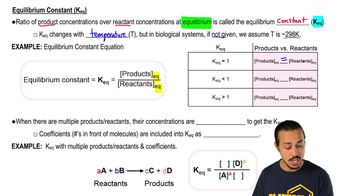
  • How is the equilibrium constant defined in terms of concentrations?

    The equilibrium constant is the ratio of product concentrations to reactant concentrations at equilibrium.
  • What does an equilibrium constant equal to 1 indicate about the reaction?

    It indicates that the concentrations of products and reactants are equal at equilibrium.
  • What does an equilibrium constant less than 1 indicate?

    It means reactants predominate over products at equilibrium.
  • What does an equilibrium constant greater than 1 indicate?

    It means products predominate over reactants at equilibrium.
  • How are coefficients in a reaction included in the equilibrium constant calculation?

    Coefficients are included as exponents in the equilibrium constant expression.
  • What happens to the equilibrium constant when temperature changes?

    The equilibrium constant changes with temperature.
  • What temperature is typically assumed for biological systems when calculating equilibrium constants?

    A temperature of 298 Kelvin (25 degrees Celsius) is usually assumed.
  • At equilibrium, is the concentration of reactants always equal to the concentration of products?

    No, the concentrations do not have to be equal; only the rates of the forward and reverse reactions must be equal.
  • What happens if the concentration of a reactant is greater than its equilibrium concentration?

    The reaction will proceed in the forward direction to restore equilibrium.
  • What happens if the concentration of a product is greater than its equilibrium concentration?

    The reaction will proceed in the reverse direction to restore equilibrium.
  • Why is the system most stable at equilibrium?

    Because the system's energy is at its minimum at equilibrium.
  • How do you write the equilibrium constant for a reaction with multiple products and reactants?

    Multiply the concentrations of each product and reactant, raising each to the power of its coefficient, and divide products by reactants.