Back

Facilitated Diffusion quiz

Control buttons has been changed to "navigation" mode.
1/15
  • What is facilitated diffusion?

    Facilitated diffusion is a type of passive transport that requires no energy and uses membrane proteins to move solutes across the membrane.
  • What differentiates facilitated diffusion from simple diffusion?

    Facilitated diffusion requires a membrane protein to move solutes, while simple diffusion does not.
  • What are the two main types of membrane proteins involved in facilitated diffusion?

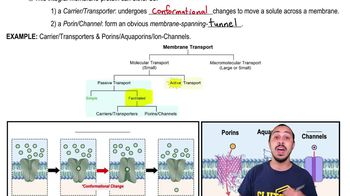
    The two main types are carriers/transporters and porins/channels.
  • How do carrier/transporters move solutes across the membrane?

    Carriers/transporters undergo conformational changes to transport solutes across the membrane.
  • Do porins or channels undergo conformational changes during facilitated diffusion?

    No, porins and channels do not undergo conformational changes; they form a membrane-spanning tunnel.
  • What is the main structural feature of porins and channels?

    Porins and channels have an obvious membrane-spanning tunnel that allows solutes to pass through.
  • What is a unique feature of carrier/transporters compared to porins/channels?

    Carrier/transporters do not have a clear membrane-spanning tunnel and rely on conformational changes to move solutes.
  • What are aquaporins?

    Aquaporins are specialized porins that allow water molecules to diffuse rapidly through the membrane.
  • What type of molecules do ion channels allow to pass through the membrane?

    Ion channels permit specific ions to diffuse through the membrane non-energetically.
  • Is energy required for facilitated diffusion?

    No, facilitated diffusion is a passive process and does not require energy.
  • What happens to a carrier/transporter after it releases a molecule?

    After releasing a molecule, the carrier/transporter returns to its original position to transport more molecules.
  • What is the role of the concentration gradient in facilitated diffusion?

    Solutes move down their concentration gradient during facilitated diffusion, from high to low concentration.
  • Are the terms 'carrier' and 'transporter' interchangeable?

    Yes, 'carrier' and 'transporter' are interchangeable terms for these membrane proteins.
  • What is the key distinction between carriers and porins/channels?

    Carriers undergo conformational changes, while porins/channels have a clear membrane-spanning tunnel.
  • Why are aquaporins important in facilitated diffusion?

    Aquaporins are important because they enable water to diffuse across the membrane much faster than by simple diffusion.