Back

FDNB quiz

Control buttons has been changed to "navigation" mode.
1/15
  • What does FDNB stand for and what is its common alternative name?

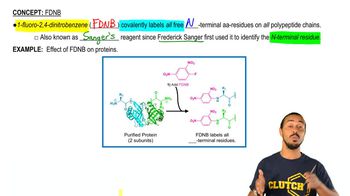
    FDNB stands for 1-fluoro-2,4-dinitrobenzene and is also known as Sanger's reagent.
  • What specific part of a polypeptide does FDNB label?

    FDNB covalently labels the free N-terminal amino acid residues of all polypeptide chains in a protein sample.
  • Why is FDNB useful for studying proteins with multiple subunits?

    FDNB labels the N-terminal residue of each polypeptide chain, allowing identification of the number of subunits in a protein.
  • What happens to the protein after FDNB treatment and subsequent hydrolysis with hydrochloric acid?

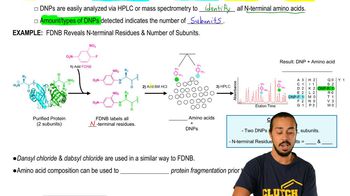
    The protein is completely hydrolyzed, releasing all amino acids, with the N-terminal residues being released as dinitrophenyl derivatives (DNPs).
  • How are the DNP derivatives analyzed after FDNB treatment and hydrolysis?

    DNP derivatives are analyzed using techniques such as HPLC (High Performance Liquid Chromatography) or mass spectrometry.
  • What information can be obtained by analyzing the DNP derivatives from a protein sample?

    The identity of the N-terminal amino acid residues and the number of subunits in the protein can be determined.
  • If a protein has three polypeptide chains, how many N-terminal residues will be labeled by FDNB?

    All three N-terminal residues, one from each polypeptide chain, will be labeled by FDNB.
  • What does the presence of two different DNP derivatives in an HPLC chromatogram indicate about a protein?

    It indicates that the protein has two subunits, each with a different N-terminal amino acid.
  • Why does FDNB not label the C-terminal amino acid residues?

    FDNB specifically reacts with free N-terminal amino groups and does not react with C-terminal residues.
  • What is the significance of the squiggly lines shown in diagrams of FDNB-labeled proteins?

    The squiggly lines represent the rest of the polypeptide chain, which is not affected by FDNB labeling.
  • What is the main takeaway from using FDNB in protein analysis?

    FDNB reveals the N-terminal residues and the number of subunits in a protein.
  • What other chemicals can be used similarly to FDNB for labeling N-terminal residues?

    Dansyl chloride and dabsyl chloride can also be used to label N-terminal amino acid residues in a similar way.
  • How does the detection of DNP derivatives help in protein sequencing strategies?

    Knowing the N-terminal residues and subunit composition helps strategize protein fragmentation prior to sequencing.
  • What is the role of 6M hydrochloric acid in the FDNB method?

    6M hydrochloric acid is used to completely hydrolyze the protein, breaking all peptide bonds and releasing amino acids.
  • How can DNP-labeled N-terminal residues be distinguished from other amino acids in analysis?

    DNP-labeled N-terminal residues produce unique peaks in HPLC or mass spectrometry, distinct from unlabeled amino acids.