Back

Gluconeogenesis 1 quiz

Control buttons has been changed to "navigation" mode.
1/15
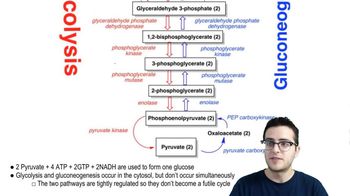
  • Which three glycolysis reactions require different enzymes in gluconeogenesis due to their highly favorable energetics?

    Reactions 1, 3, and 10 require different enzymes in gluconeogenesis because their energetics make them irreversible.
  • Why are most glycolysis enzymes reused in gluconeogenesis?

    Most glycolysis enzymes are reused because their reactions are readily reversible, allowing them to catalyze the reverse process.
  • Which molecules from fats can enter gluconeogenesis?

    Only glycerol from fats can enter gluconeogenesis; fatty acids and sterols cannot.
  • Which amino acids cannot be used as substrates for gluconeogenesis?

    Lysine and leucine cannot be used as substrates for gluconeogenesis.
  • What is the energy requirement for synthesizing one glucose molecule from two pyruvate in gluconeogenesis?

    Gluconeogenesis requires 4 ATP, 2 GTP, and 2 NADH to synthesize one glucose molecule from two pyruvate.
  • How does the energy cost of gluconeogenesis compare to glycolysis?

    Gluconeogenesis is more energy-intensive than glycolysis, using more ATP and GTP than glycolysis yields.
  • Where in the cell do glycolysis and gluconeogenesis occur?

    Both glycolysis and gluconeogenesis occur in the cytosol.
  • What is a futile cycle in the context of glycolysis and gluconeogenesis?

    A futile cycle occurs when both pathways run simultaneously, causing energy waste without net gain.
  • How are glycolysis and gluconeogenesis regulated to prevent futile cycles?

    They are tightly regulated so that when one pathway is active, the other is shut off.
  • What happens to ketogenic amino acids in gluconeogenesis?

    Ketogenic amino acids can only contribute specific carbons to gluconeogenesis; others become ketone bodies.
  • What is the main purpose of gluconeogenesis during periods of intense energy demand?

    Gluconeogenesis provides glucose for cells to continue glycolysis when energy demand is high.
  • Which molecule is a starting material for gluconeogenesis besides amino acids and glycerol?

    Lactate is a starting material for gluconeogenesis.
  • Why do cells need to regulate the direction of shared enzymes in glycolysis and gluconeogenesis?

    Shared enzymes can catalyze reversible reactions, so regulation ensures they push reactions in the correct direction.
  • What is the relationship between the activity of glycolytic-specific and gluconeogenic-specific enzymes?

    When glycolytic-specific enzymes are active, gluconeogenic-specific enzymes are inactive, and vice versa.
  • Why is the regulation of reactions 1, 3, and 10 important in glycolysis and gluconeogenesis?

    These reactions are key regulatory points because their enzymes drive the direction and control of the pathways.