Back

Glycogen definitions

Control buttons has been changed to "navigation" mode.
1/15
  • Glycogen

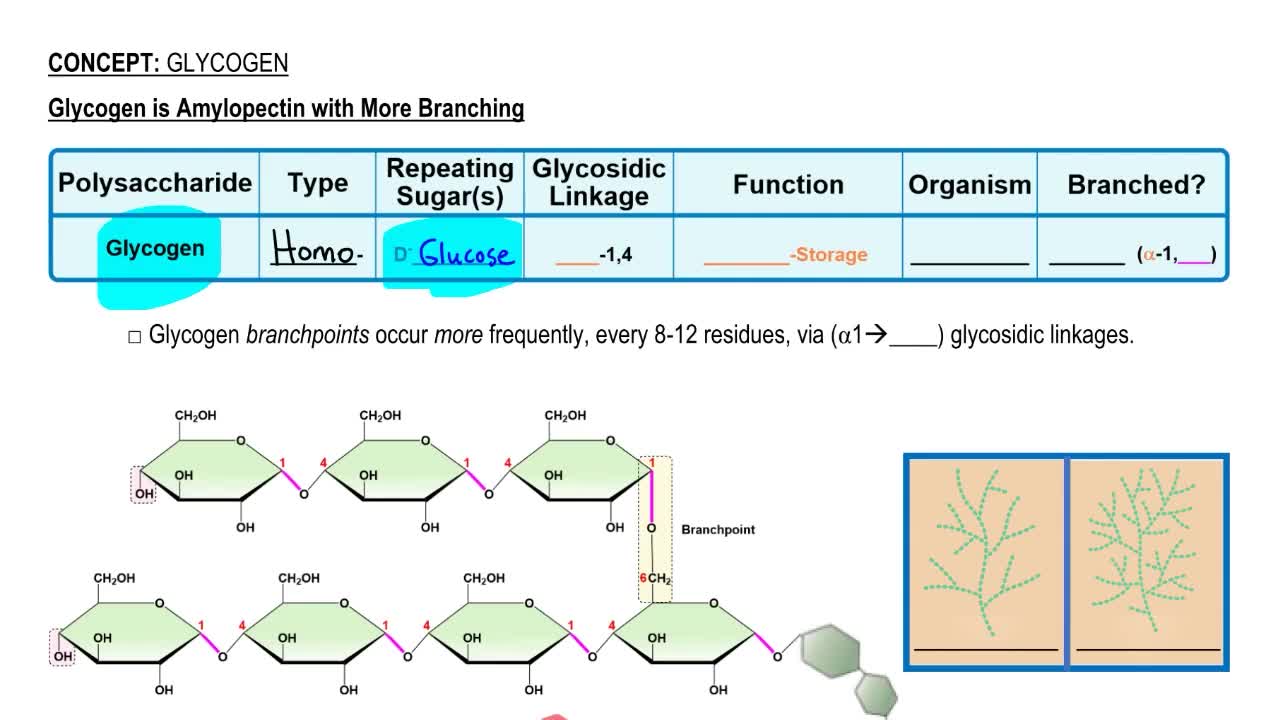
    A highly branched homopolysaccharide of D-glucose serving as the main energy storage molecule in animal cells.
  • Homopolysaccharide

    A polymer consisting of only one type of repeating sugar unit, such as D-glucose in glycogen.
  • D-glucose

    A monosaccharide forming the repeating unit in glycogen, amylopectin, cellulose, and starch.
  • Alpha-1,4-glycosidic linkage

    A covalent bond connecting glucose units in the main chain of glycogen, associated with energy storage.
  • Alpha-1,6-glycosidic linkage

    A covalent bond forming branch points in glycogen and amylopectin, occurring more frequently in glycogen.
  • Branch point

    A location in glycogen where a new chain of glucose units diverges, linked by alpha-1,6-glycosidic bonds.
  • Amylopectin

    A branched homopolysaccharide in plants, similar to glycogen but with fewer branch points.
  • Amylose

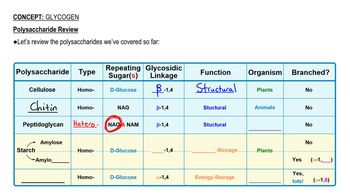
    An unbranched form of starch in plants, composed of D-glucose units linked by alpha-1,4-glycosidic bonds.
  • Starch

    A plant polysaccharide with both branched (amylopectin) and unbranched (amylose) forms, storing energy.
  • Cellulose

    A structural homopolysaccharide in plants, composed of D-glucose units linked by beta-1,4-glycosidic bonds.
  • Chitin

    A structural homopolysaccharide of N-acetylglucosamine, forming exoskeletons in insects and crustaceans.
  • Peptidoglycan

    A heteropolysaccharide of N-acetylglucosamine and N-acetylmuramic acid, forming bacterial cell walls.
  • Beta-1,4-glycosidic linkage

    A covalent bond connecting sugar units in structural polysaccharides like cellulose, chitin, and peptidoglycan.
  • Energy storage

    A function of polysaccharides with alpha-glycosidic linkages, such as glycogen and starch, in cells.
  • Structural function

    A role of polysaccharides with beta-glycosidic linkages, providing rigidity in cell walls and exoskeletons.