Back

Hill Equation definitions

Control buttons has been changed to "navigation" mode.
1/15
  • Hill Equation

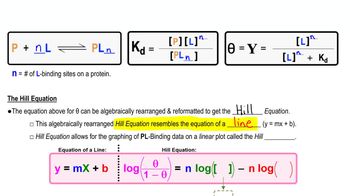
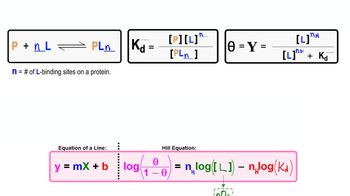
    Describes cooperative ligand binding in allosteric proteins, allowing data to be plotted as a straight line for easier interpretation.
  • Cooperativity

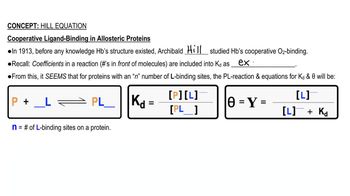
    Refers to the influence that binding of one ligand has on the binding of additional ligands to a protein.
  • Allosteric Protein

    A protein whose function is regulated by the binding of a ligand at a site other than the active site.
  • Hemoglobin

    An allosteric protein with four ligand binding sites, exhibiting cooperative oxygen binding behavior.
  • Ligand Binding Site

    A specific region on a protein where a ligand molecule can attach, influencing protein activity.
  • Hill Constant

    A value indicating the degree of cooperativity in ligand binding, ranging from 0 to the number of binding sites.
  • Hill Plot

    A linear graph used to analyze protein-ligand binding data, derived from the Hill Equation.
  • Fractional Saturation

    Represents the proportion of protein binding sites occupied by ligand molecules.
  • Dissociation Equilibrium Constant

    A measure of a protein's affinity for its ligand, affected by cooperativity and raised to the power of the Hill constant.
  • Concerted Model

    A model of cooperativity where all subunits of a protein change conformation simultaneously upon ligand binding.
  • Sequential Model

    A model of cooperativity where subunits change conformation one at a time as ligands bind.
  • Positive Cooperativity

    Occurs when binding of one ligand increases the affinity for subsequent ligand binding.
  • Negative Cooperativity

    Occurs when binding of one ligand decreases the affinity for subsequent ligand binding.
  • Partial Pressure of Oxygen

    Used as a measure of ligand concentration in hemoglobin binding studies.
  • Hill Coefficient

    Another term for the Hill constant, quantifying the degree of cooperativity in ligand binding.