Back

Integral Membrane Proteins definitions

Control buttons has been changed to "navigation" mode.
1/15
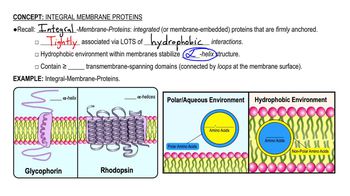
  • Integral Membrane Protein

    Membrane-embedded molecule tightly anchored within the lipid bilayer, often requiring detergents for isolation due to strong membrane association.
  • Lipid Bilayer

    Double-layered structure forming the membrane, providing a hydrophobic environment that stabilizes certain protein conformations.
  • Alpha Helix

    Spiral secondary structure frequently found in membrane-embedded proteins, stabilized by hydrophobic surroundings.
  • Transmembrane Spanning Domain

    Segment crossing the membrane, typically composed of an alpha helix, anchoring the protein within the bilayer.
  • Loop

    Flexible connector linking multiple transmembrane domains, often located at the membrane surface.
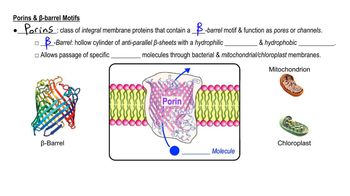
  • Porin

    Channel-forming protein with a beta barrel motif, facilitating passage of specific polar molecules across membranes.
  • Beta Barrel

    Cylindrical motif formed by anti-parallel beta sheets, creating a hydrophilic interior and hydrophobic exterior.
  • Anti-parallel Beta Sheet

    Secondary structure where adjacent strands run in opposite directions, contributing to beta barrel formation.
  • Hydrophobic Environment

    Non-polar region within the membrane, stabilizing certain protein structures and influencing folding patterns.
  • Hydrophilic Interior

    Water-attracting central region of a beta barrel, enabling selective passage of polar molecules.
  • Hydrophobic Exterior

    Outer surface of a beta barrel motif, interacting with the membrane's non-polar lipid environment.
  • Motif

    Distinct pattern or combination of secondary structures within a protein, such as the beta barrel.
  • Glycophorin

    Example of a membrane protein with a single alpha helix, illustrating a single transmembrane domain.
  • Rhodopsin

    Membrane protein with multiple alpha helices, demonstrating several transmembrane domains.
  • Endosymbiotic Theory

    Concept explaining the presence of porins in mitochondria and chloroplasts due to their bacterial ancestry.