Back

Membrane Structure 2 definitions

Control buttons has been changed to "navigation" mode.
1/15
  • Membrane Protein

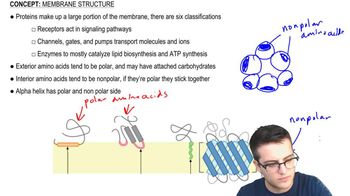
    Major membrane component classified into six types, serving roles such as receptors, channels, gates, pumps, and enzymes.
  • Receptor

    Membrane-associated structure involved in signaling pathways, enabling cells to respond to external stimuli.
  • Channel

    Membrane protein facilitating the passage of molecules across the lipid bilayer, often selective for specific substances.
  • Pump

    Membrane protein actively transporting molecules against concentration gradients, often requiring energy input.
  • Enzyme

    Membrane protein catalyzing reactions such as lipid biosynthesis or ATP synthesis within or near the membrane.
  • Alpha Helix

    Protein secondary structure with alternating polar and non-polar sides, influencing membrane interaction.
  • Phospholipid

    Membrane molecule associating with both interior and exterior protein surfaces, enabling hydrophobic interactions.
  • Hydropathy Index

    Numerical scale indicating hydrophobic or hydrophilic regions in proteins, with positive values for internal segments.
  • Hydrophobic Region

    Protein segment with positive hydropathy values, typically located within the membrane's internal environment.
  • Hydrophilic Region

    Protein segment with negative hydropathy values, usually exposed to the aqueous environment outside the membrane.
  • Tryptophan

    Amino acid commonly found at the edge of membranes in transmembrane proteins, sharing properties with tyrosine.
  • Tyrosine

    Amino acid frequently located at membrane boundaries in transmembrane proteins, often paired with tryptophan.
  • Peripheral Protein

    Membrane protein attached to a fatty acid embedded in the membrane, not spanning the lipid bilayer.
  • Fatty Acid

    Hydrophobic molecule embedded in the membrane, serving as an anchor for peripheral proteins.
  • Polarity

    Characteristic of amino acids determining their location in membrane proteins, with polar residues external and non-polar internal.