Back

Monosaccharides definitions

Control buttons has been changed to "navigation" mode.
1/15
  • Monosaccharide

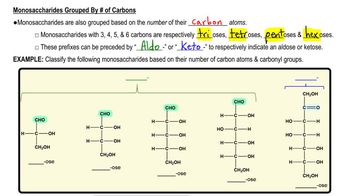
    Individual carbohydrate unit, simplest sugar, often named with 'ose' suffix and forms the basis for larger carbohydrates.
  • Aldose

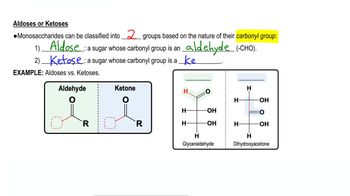
    Sugar with a carbonyl group as an aldehyde, located at the end of the molecule and abbreviated as CHO.
  • Ketose

    Sugar with a carbonyl group as a ketone, positioned within the molecule and attached to two R groups.
  • Carbonyl Group

    Functional group consisting of a carbon double-bonded to oxygen, crucial for classifying sugars as aldoses or ketoses.
  • Aldehyde

    Carbonyl-containing group found at the end of a molecule, often signified by the presence of hydrogen.
  • Ketone

    Carbonyl-containing group located within a molecule, bonded to two carbon-based R groups.
  • Triose

    Monosaccharide containing three carbon atoms, prefix 'tri-' indicates its carbon count.
  • Tetrose

    Monosaccharide containing four carbon atoms, prefix 'tetra-' reveals its carbon count.
  • Pentose

    Monosaccharide with five carbon atoms, prefix 'penta-' denotes its carbon count.
  • Hexose

    Monosaccharide with six carbon atoms, prefix 'hexa-' indicates its carbon count.
  • Heptose

    Monosaccharide with seven carbon atoms, prefix 'hepta-' signifies its carbon count.
  • Aldotriose

    Three-carbon sugar with an aldehyde group, combining 'aldo-' and 'triose' for structural classification.
  • Ketoheptose

    Seven-carbon sugar with a ketone group, combining 'keto-' and 'heptose' for structural classification.
  • Fischer Projection

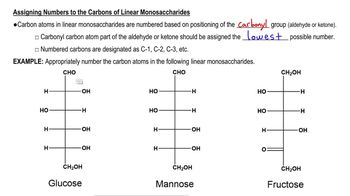
    Two-dimensional representation used to display the structure and carbon numbering of linear monosaccharides.
  • Glucose

    Six-carbon aldose sugar, carbonyl group at the end, commonly used as a reference for carbon numbering.