Back

Mutarotation definitions

Control buttons has been changed to "navigation" mode.
1/15
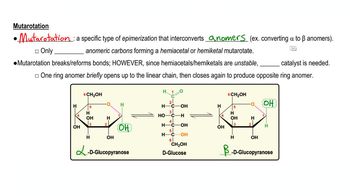
  • Mutarotation

    Interconversion between alpha and beta anomers of sugars via ring opening and closing, occurring without a catalyst.
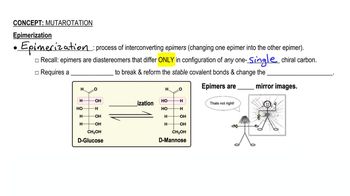
  • Epimerization

    Conversion between epimers, requiring a catalyst to break and reform stable covalent bonds at a single chiral carbon.
  • Anomer

    Type of stereoisomer differing at the anomeric carbon, resulting in distinct alpha and beta forms in cyclic sugars.
  • Alpha Anomer

    Cyclic sugar form with the hydroxyl group on the anomeric carbon opposite to the highest numbered carbon.
  • Beta Anomer

    Cyclic sugar form with the hydroxyl group on the anomeric carbon on the same side as the highest numbered carbon.
  • Diastereomer

    Non-mirror image stereoisomer differing in configuration at one or more chiral centers, including epimers.
  • Epimer

    Diastereomer differing in configuration at only one chiral carbon, such as D-glucose and D-mannose.
  • Chiral Carbon

    Carbon atom bonded to four distinct groups, creating stereoisomerism in sugars.
  • Anomeric Carbon

    Carbon derived from the carbonyl group during ring formation, determining alpha or beta configuration.
  • Hemiacetal

    Functional group formed when an aldehyde reacts with an alcohol, present at the anomeric carbon in cyclic sugars.
  • Hemiketal

    Functional group formed when a ketone reacts with an alcohol, found at the anomeric carbon in some cyclic sugars.
  • Monosaccharide

    Simple sugar molecule capable of cyclizing to form anomers and undergoing mutarotation.
  • Catalyst

    Substance, often an enzyme, required to facilitate epimerization by breaking and reforming covalent bonds.
  • Linear Form

    Open-chain structure of a sugar, intermediate during mutarotation before ring closure to form anomers.
  • Configuration

    Spatial arrangement of atoms around a chiral center, determining the identity of epimers and anomers.