Back

Nucleic Acids 4 definitions

Control buttons has been changed to "navigation" mode.
1/15
  • Double Helix

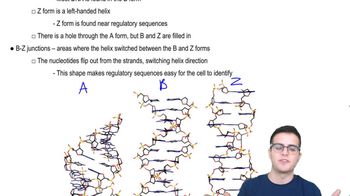
    A structure with two intertwined strands, exhibiting distinct forms that impact stability and regulatory functions in nucleic acids.
  • B Form

    The most prevalent right-handed helix in DNA, stabilized by hydrophobic stacking and hydrogen bonds, crucial for genomic integrity.
  • A Form

    A condensed right-handed helix, typically seen in double-stranded RNA, with a central hollow space distinguishing it from other forms.
  • Z Form

    A left-handed helix found near regulatory sequences, marked by abrupt shape changes and nucleotide flipping at junctions.
  • Regulatory Sequence

    A DNA region influencing gene expression, often associated with structural transitions and unique helix conformations.
  • BZ Junction

    A site where DNA switches between B and Z forms, causing nucleotide flipping and altering helix directionality.
  • Hydrophobic Stacking

    Interactions between bases in nucleic acids that stabilize the helix by minimizing exposure to water.
  • Hydrogen Bond

    A weak interaction between complementary bases, essential for holding together the strands of nucleic acids.
  • Conformation

    The three-dimensional arrangement of nucleic acid strands, determining their functional and regulatory properties.
  • Phosphate Group

    A charged component on the DNA backbone, interacting with water to stabilize the molecule's external structure.
  • Nucleotide

    A molecular unit in nucleic acids, capable of flipping out at junctions to facilitate structural transitions.
  • Right-Handed Helix

    A spiral structure where the strands twist in a clockwise direction, characteristic of A and B forms.
  • Left-Handed Helix

    A spiral structure with strands twisting counterclockwise, unique to the Z form of DNA.
  • Genomic Stability

    The maintenance of DNA structure and integrity, influenced by helix conformation and molecular interactions.
  • Aqueous Environment

    The water-rich cellular setting surrounding DNA, contributing to the stabilization of its external structure.