Back

Ordering Cleaved Fragments definitions

Control buttons has been changed to "navigation" mode.
1/15
  • Edmond Degradation

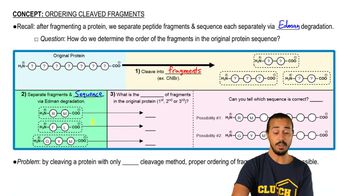
    A sequencing method limited to peptides with fewer than 50 amino acid residues, requiring prior fragmentation of larger proteins.
  • Cyanogen Bromide

    A chemical reagent used to cleave proteins specifically at methionine residues on the carboxyl side, generating peptide fragments.
  • Chymotrypsin

    A protease that cleaves proteins at specific sites, producing fragments distinct from those generated by chemical cleavage.
  • Peptide Fragment

    A short sequence of amino acids produced by cleaving a larger protein, which can be sequenced individually.
  • Amino Acid Residue

    A single unit within a peptide or protein, often represented by a one-letter code after sequencing.
  • Protein Sequence

    The specific order of amino acid residues in a protein, revealed by aligning overlapping peptide fragments.
  • Chemical Cleavage

    A technique using reagents to break proteins at specific amino acid sites, facilitating fragment generation for sequencing.
  • Protease

    An enzyme that catalyzes the hydrolysis of peptide bonds, producing fragments for sequencing.
  • Overlap

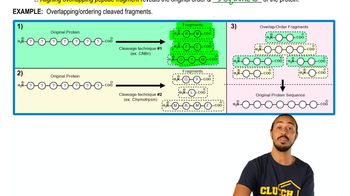
    Shared amino acid sequences between fragments from different cleavage methods, used to reconstruct the original protein sequence.
  • N Terminal

    The starting end of a protein or peptide, defined by the presence of a free amino group.
  • C Terminal

    The ending end of a protein or peptide, characterized by a free carboxyl group.
  • Cleavage Technique

    A method or reagent used to break proteins into smaller fragments, each producing a unique set of peptides.
  • Fragment Alignment

    The process of arranging overlapping peptide fragments to deduce the original sequence of a protein.
  • One-Letter Code

    A shorthand notation for amino acid residues, used to represent sequences after fragment sequencing.
  • Methionine

    An amino acid residue targeted by cyanogen bromide for cleavage, often marking fragment boundaries.