Back

Peptidoglycan definitions

Control buttons has been changed to "navigation" mode.
1/13
  • Peptidoglycan

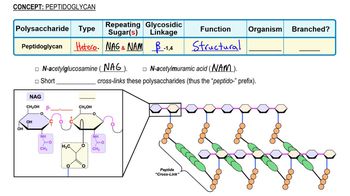
    A heteropolysaccharide forming the main structural component of bacterial cell walls, composed of alternating NAG and NAM units.
  • Heteropolysaccharide

    A carbohydrate polymer made from two or more different types of sugar units, providing structural diversity.
  • N-acetylglucosamine

    A sugar unit found in peptidoglycan and chitin, abbreviated as NAG, contributing to bacterial cell wall structure.
  • N-acetylmuramic acid

    A sugar unit unique to peptidoglycan, abbreviated as NAM, distinguished by a carboxylic acid group and peptide linkage.
  • Beta-1,4 glycosidic linkage

    A covalent bond connecting NAG and NAM in peptidoglycan, crucial for structural integrity and rigidity.
  • Bacterial cell wall

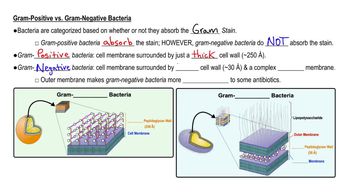
    A protective layer surrounding bacteria, primarily composed of peptidoglycan, varying in thickness by Gram type.
  • Gram positive bacteria

    Bacteria with a thick peptidoglycan cell wall, absorbing Gram stain and lacking a complex outer membrane.
  • Gram negative bacteria

    Bacteria with a thin peptidoglycan cell wall, surrounded by a complex outer membrane containing lipopolysaccharides.
  • Outer membrane

    A lipid-rich layer found in Gram negative bacteria, providing additional protection and antibiotic resistance.
  • Lipopolysaccharide

    A molecule in the outer membrane of Gram negative bacteria, consisting of polysaccharides linked to lipids.
  • Peptide cross-link

    Short peptide chains connecting polysaccharide strands in peptidoglycan, enhancing cell wall strength.
  • Polysaccharide

    A carbohydrate polymer made of repeating sugar units, forming the backbone of peptidoglycan.
  • Cell membrane

    A phospholipid bilayer beneath the cell wall, maintaining cellular integrity in both Gram positive and negative bacteria.