Back

Peripheral Membrane Proteins definitions

Control buttons has been changed to "navigation" mode.
1/13
  • Lipid Bilayer

    Structure composed of two layers of phospholipids forming the fundamental framework of cellular membranes.
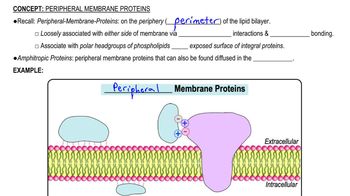
  • Peripheral Membrane Protein

    Molecule loosely attached to the membrane surface, easily removed by changes in pH or ionic strength.
  • Integral Membrane Protein

    Molecule embedded within the membrane, tightly associated through hydrophobic interactions.
  • Electrostatic Interaction

    Attraction between charged groups, enabling association of certain proteins with membrane surfaces.
  • Hydrogen Bonding

    Weak interaction involving hydrogen atoms, facilitating protein association with membrane polar head groups.
  • Phospholipid

    Amphipathic molecule forming the main component of cellular membranes, with polar heads and fatty acid tails.
  • Polar Head Group

    Hydrophilic region of a phospholipid, interacting with proteins through electrostatic and hydrogen bonds.
  • Fatty Acid Chain

    Hydrophobic tail of a phospholipid, involved in membrane structure and integral protein association.
  • Extracellular Side

    Region outside the cell membrane where certain proteins can associate with the membrane.
  • Intracellular Side

    Region inside the cell membrane, including the cytosol, where proteins may interact with the membrane.
  • Cytosol

    Aqueous solution within cells, allowing certain proteins to diffuse away from the membrane.
  • Amphitropic Protein

    Type of protein capable of associating with the membrane or diffusing freely in the cytosol.
  • Ionic Strength

    Measure of ion concentration in solution, affecting the association of certain proteins with membranes.