Back

Peripheral Membrane Proteins quiz

Control buttons has been changed to "navigation" mode.
1/15
  • Where are peripheral membrane proteins located relative to the lipid bilayer?

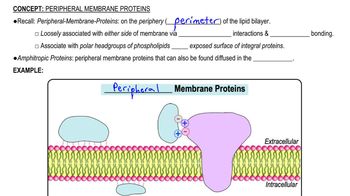
    Peripheral membrane proteins are found on the periphery or perimeter of the lipid bilayer, not integrated into the membrane.
  • How are peripheral membrane proteins different from integral membrane proteins in terms of membrane association?

    Peripheral membrane proteins are loosely associated with the membrane, while integral membrane proteins are tightly integrated into it.
  • What makes it easy to remove peripheral membrane proteins from the membrane?

    Peripheral membrane proteins can be easily removed by changes in pH or ionic strength due to their loose association.
  • On which sides of the membrane can peripheral membrane proteins be found?

    Peripheral membrane proteins can be found on both the extracellular and intracellular sides of the membrane.
  • What types of interactions allow peripheral membrane proteins to associate with the membrane?

    Peripheral membrane proteins associate with the membrane via electrostatic interactions and hydrogen bonding.
  • How do integral membrane proteins primarily associate with the membrane?

    Integral membrane proteins primarily associate with the membrane through hydrophobic interactions with fatty acid chains.
  • Do peripheral membrane proteins interact with fatty acid chains of phospholipids?

    No, peripheral membrane proteins do not interact with fatty acid chains; they interact with polar head groups or exposed surfaces of integral proteins.
  • How can peripheral membrane proteins associate directly with the membrane?

    They can associate directly by interacting with the polar head groups of phospholipids.
  • How can peripheral membrane proteins associate indirectly with the membrane?

    They can associate indirectly by interacting with the exposed surfaces of integral membrane proteins.
  • What is an amphitropic protein?

    An amphitropic protein is a specific type of peripheral membrane protein that can associate with the membrane or be dissolved in the cytosol.
  • Where can amphitropic proteins be found besides the membrane?

    Amphitropic proteins can be found diffused in the cytosol, which is the liquid inside the cell.
  • What allows amphitropic proteins to dissociate from the membrane?

    Their loose association via electrostatic and hydrogen bonding interactions allows them to dissociate and diffuse in the cytosol.
  • What is the main difference in the interactions of peripheral and integral membrane proteins with the membrane?

    Peripheral proteins use electrostatic and hydrogen bonding, while integral proteins use hydrophobic interactions.
  • Can peripheral membrane proteins be found only on one side of the membrane?

    No, they can be found on both the extracellular and intracellular sides.
  • What happens to peripheral membrane proteins when the ionic strength of the solution changes?

    They can be easily removed from the membrane due to their loose association.