Back

Polysaccharide definitions

Control buttons has been changed to "navigation" mode.
1/14
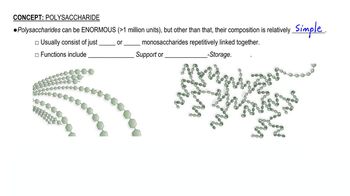
  • Polysaccharide

    Largest carbohydrate class, often exceeding a million sugar units, with simple composition and diverse structural or storage roles.
  • Monosaccharide

    Basic sugar unit repetitively linked to form larger carbohydrate structures, influencing overall properties.
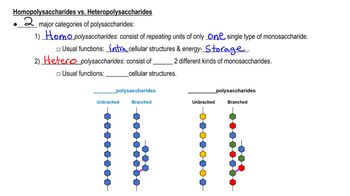
  • Homopolysaccharide

    Structure composed of repeating units of a single sugar type, typically serving intracellular or energy storage functions.
  • Heteropolysaccharide

    Structure containing two or more different sugar types, often forming extracellular components.
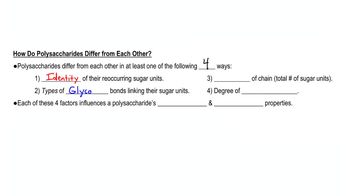
  • Glycosidic Bond

    Covalent linkage joining sugar units, with variations affecting physical and chemical properties.
  • Branching

    Structural feature where chains diverge from a main chain, impacting molecular shape and function.
  • Chain Length

    Total number of sugar units in a molecule, influencing size and functional characteristics.
  • Linear Form

    Arrangement where sugar units connect in a straight, unbranched chain, affecting physical properties.
  • Energy Storage

    Functional role where carbohydrate structures serve as reserves for cellular fuel.
  • Structural Support

    Functional role where carbohydrate structures provide stability and integrity to cells or tissues.
  • Physical Properties

    Characteristics such as solubility and shape, determined by sugar identity, bond type, chain length, and branching.
  • Chemical Properties

    Reactivity and interaction traits influenced by composition and structure of carbohydrate molecules.
  • Intracellular Structure

    Component located within cells, often formed by repeating sugar units for support or storage.
  • Extracellular Structure

    Component found outside cells, typically composed of multiple sugar types for external support.