Back

Practice - Bioenergetics 2 quiz

Control buttons has been changed to "navigation" mode.
1/15
  • What role does ATP play in muscle contraction?

    ATP allows myosin heads to release from actin filaments, converting chemical energy into kinetic energy for muscle movement.
  • What is the essential feature of all biological redox reactions?

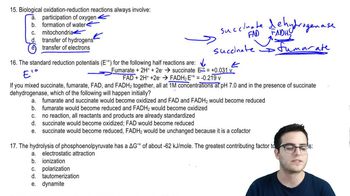
    All biological redox reactions involve the transfer of electrons.
  • Is oxygen always required for biological redox reactions?

    No, oxygen often participates but is not required for all redox reactions.
  • What does succinate dehydrogenase catalyze?

    Succinate dehydrogenase catalyzes the conversion of succinate to fumarate, forming FADH2 from FAD in the process.
  • Under standard conditions, what determines the direction of a redox reaction?

    The direction is determined by the standard reduction potentials; the reaction proceeds in the direction with the greatest positive E'° value.
  • What happens if the standard reduction potential favors the reverse reaction in the succinate/fumarate system?

    Fumarate will be reduced to succinate, and FADH2 will be oxidized to FAD.
  • Why is the hydrolysis of phosphoenolpyruvate (PEP) highly exergonic?

    The reaction is highly exergonic due to the tautomerization of pyruvate from the enol form to the more stable keto form.
  • What is the equation for calculating ΔG'° from the equilibrium constant (Keq)?

    ΔG'° = -RT ln(Keq), where R is the gas constant and T is temperature in Kelvin.
  • How do you calculate ΔG under cellular conditions?

    ΔG = ΔG'° + RT ln(Q), where Q is the ratio of product to reactant concentrations.
  • What does the reaction quotient Q represent in the ΔG equation?

    Q is the ratio of the concentrations of products to reactants at a given moment during the reaction.
  • If Keq for a reaction is 1.97 and RT is 2.5 kJ/mol, what is ΔG'°?

    ΔG'° = -2.5 kJ/mol × ln(1.97) = -1.7 kJ/mol.
  • If the product concentration is 0.6 mM and the reactant is 1.2 mM, what is Q?

    Q = 0.6 mM / 1.2 mM = 0.5.
  • Given ΔG'° = -1.7 kJ/mol, RT = 2.5 kJ/mol, and Q = 0.5, what is ΔG?

    ΔG = -1.7 kJ/mol + 2.5 kJ/mol × ln(0.5) = -3.4 kJ/mol.
  • Why might the direction of a reaction under standard conditions differ from that in cells?

    Standard conditions use 1 M concentrations and pH 7, which may not reflect actual cellular concentrations, affecting reaction direction.
  • What is the main factor that makes the hydrolysis of PEP so favorable?

    The main factor is the tautomerization of pyruvate from the enol to the keto form after PEP hydrolysis.