Back

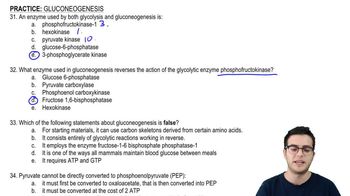
Practice - Gluconeogenesis definitions

Control buttons has been changed to "navigation" mode.
1/15
  • Glycolysis

    A metabolic pathway breaking down glucose to pyruvate, generating ATP and involving both reversible and irreversible enzymatic steps.
  • Gluconeogenesis

    A biosynthetic pathway producing glucose from non-carbohydrate precursors, requiring unique enzymes for irreversible steps.
  • 3-Phosphoglycerate Kinase

    An enzyme shared by glycolysis and gluconeogenesis, catalyzing ATP generation from 1,3-bisphosphoglycerate to 3-phosphoglycerate.
  • Phosphofructokinase-1

    A glycolytic enzyme catalyzing the third step, converting fructose 6-phosphate to fructose 1,6-bisphosphate, crucial for pathway regulation.
  • Fructose 1,6-Bisphosphatase

    A gluconeogenic enzyme reversing phosphofructokinase-1 action, removing phosphate from fructose 1,6-bisphosphate.
  • Pyruvate Kinase

    A glycolytic enzyme catalyzing the final step, converting phosphoenolpyruvate to pyruvate, an energetically favorable reaction.
  • Glucose 6-Phosphatase

    A liver-specific enzyme catalyzing the last step of gluconeogenesis, removing phosphate from glucose to release free glucose.
  • Oxaloacetate

    An intermediate formed from pyruvate during gluconeogenesis, required for conversion to phosphoenolpyruvate.
  • Phosphoenolpyruvate

    A high-energy intermediate in glycolysis and gluconeogenesis, formed from oxaloacetate in gluconeogenesis.
  • ATP

    A nucleotide serving as the primary energy currency, consumed and generated during glycolysis and gluconeogenesis.
  • GTP

    A guanine nucleotide required for converting oxaloacetate to phosphoenolpyruvate in gluconeogenesis.
  • Substrate-Level Phosphorylation

    A process generating ATP directly from a metabolic intermediate, exemplified by 3-phosphoglycerate kinase action.
  • Irreversible Step

    A reaction in glycolysis or gluconeogenesis that cannot be reversed by the same enzyme, requiring unique regulation.
  • Futile Cycle

    A wasteful metabolic loop where opposing pathways run simultaneously, leading to energy loss without net product formation.
  • Metabolic Regulation

    The control mechanisms ensuring glycolysis and gluconeogenesis do not occur simultaneously, maintaining cellular efficiency.