Back

Practice - Gluconeogenesis quiz

Control buttons has been changed to "navigation" mode.
1/15
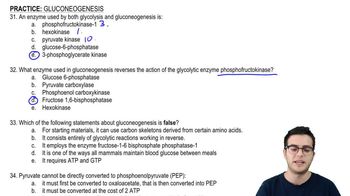
  • Which enzyme is used by both glycolysis and gluconeogenesis to catalyze the conversion of 1,3-bisphosphoglycerate to 3-phosphoglycerate?

    3-phosphoglycerate kinase is used by both pathways to convert 1,3-bisphosphoglycerate to 3-phosphoglycerate, generating ATP.
  • What is the main function of 3-phosphoglycerate kinase in glycolysis?

    It catalyzes substrate-level phosphorylation, generating ATP from ADP during the conversion of 1,3-bisphosphoglycerate to 3-phosphoglycerate.
  • Which enzyme in gluconeogenesis reverses the action of phosphofructokinase-1 from glycolysis?

    Fructose 1,6-bisphosphatase reverses the action of phosphofructokinase-1 by removing a phosphate group from fructose 1,6-bisphosphate.
  • Why can't pyruvate be directly converted to phosphoenolpyruvate (PEP) in gluconeogenesis?

    The conversion is too energetically unfavorable to be reversed in one step, so it requires two steps via oxaloacetate.
  • What are the two steps required to convert pyruvate to PEP in gluconeogenesis?

    First, pyruvate is converted to oxaloacetate (using ATP), then oxaloacetate is converted to PEP (using GTP).
  • Which enzyme catalyzes the last step of gluconeogenesis, and where is it primarily found?

    Glucose 6-phosphatase catalyzes the last step and is primarily found in liver cells.
  • Why are glycolysis and gluconeogenesis tightly regulated in cells?

    They are tightly regulated to prevent futile cycling, which would waste energy by running both pathways simultaneously.
  • How many unique reactions are required to bypass the three irreversible steps of glycolysis in gluconeogenesis?

    Four unique reactions are required because the last irreversible step of glycolysis is bypassed by two separate reactions in gluconeogenesis.
  • What is the role of phosphatases in gluconeogenesis?

    Phosphatases remove phosphate groups, reversing the actions of kinases from glycolysis.
  • Which glycolytic enzyme's action is reversed by fructose 1,6-bisphosphatase in gluconeogenesis?

    Phosphofructokinase-1's action is reversed by fructose 1,6-bisphosphatase.
  • What would happen if glycolysis and gluconeogenesis occurred simultaneously in a cell?

    They would undo each other's actions, resulting in a futile cycle and wasting cellular energy.
  • Which step of glycolysis is catalyzed by pyruvate kinase?

    Pyruvate kinase catalyzes the tenth and final step of glycolysis, converting PEP to pyruvate.
  • What energy molecules are consumed during the conversion of pyruvate to PEP in gluconeogenesis?

    ATP is consumed to convert pyruvate to oxaloacetate, and GTP is consumed to convert oxaloacetate to PEP.
  • Why can't the three irreversible steps of glycolysis be simply reversed in gluconeogenesis?

    These steps are too energetically favorable in the forward direction, requiring unique enzymes to bypass them in gluconeogenesis.
  • How is metabolic efficiency maintained between glycolysis and gluconeogenesis?

    Efficiency is maintained by tightly regulating the unique enzymes of each pathway to prevent both from operating simultaneously.