Back

Practice - Membrane Transport 2 definitions

Control buttons has been changed to "navigation" mode.
1/15
  • Facilitated Diffusion

    Movement of solutes across membranes driven by concentration differences, not requiring ATP, and exhibiting substrate specificity.
  • Primary Active Transport

    Transport process powered directly by ATP hydrolysis, establishing ion gradients across membranes.
  • Secondary Active Transport

    Transport mechanism using ion gradients, often created by primary active transport, as an energy source.
  • Selectivity Filter

    Structural feature in channels determining substrate specificity, such as favoring potassium over sodium ions.
  • Ion Channel

    Membrane protein structure, typically hydrophilic, facilitating selective ion movement across membranes.
  • Phospholipid

    Hydrophobic membrane component forming bilayers, contrasting with hydrophilic channels that interact with ions.
  • Cholesterol

    Hydrophobic molecule found in membranes, not typically present in ion channels due to their hydrophilic nature.
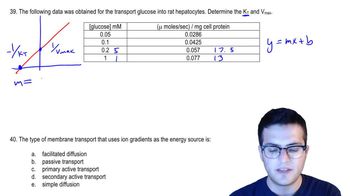
  • Lineweaver-Burk Plot

    Graphical method for analyzing transport kinetics, allowing determination of Vmax and KT from slope and intercept.
  • Vmax

    Maximum rate of substrate transport, calculated as the reciprocal of the y-intercept in kinetic analysis.
  • KT

    Transport constant analogous to Km in enzyme kinetics, determined from the x-intercept in Lineweaver-Burk analysis.
  • Slope

    Value representing the change in transport rate per unit substrate concentration, calculated as rise over run.
  • Y-intercept

    Point on a kinetic plot corresponding to the reciprocal of maximum transport rate.
  • Competitive Inhibition

    Phenomenon where one substrate reduces the transport efficiency of another by inhibiting its specific transporter.
  • Concentration Gradient

    Difference in solute concentration across a membrane, driving passive transport processes.
  • Passive Transport

    Movement of molecules across membranes without energy input, relying solely on concentration gradients.