Back

Practice - Nucleic Acids 1 definitions

Control buttons has been changed to "navigation" mode.
1/15
  • Purine

    A nitrogenous base with a fused 6-membered and 5-membered ring, found in DNA and RNA as adenine and guanine.
  • Pyrimidine

    A nitrogenous base with a single 6-membered ring, present in DNA and RNA as cytosine, thymine, and uracil.
  • Phosphodiester Bond

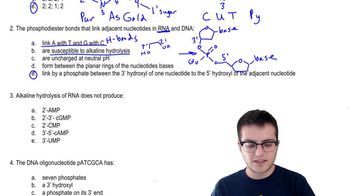
    A linkage between the 3' hydroxyl of one sugar and the 5' carbon of another, forming the backbone of nucleic acids.
  • Hydrogen Bond

    A non-covalent interaction connecting complementary bases, crucial for DNA double helix stability.
  • Ribose

    A five-carbon sugar in RNA, distinguished by a 2' hydroxyl group that increases susceptibility to alkaline hydrolysis.
  • Deoxyribose

    A five-carbon sugar in DNA, lacking a 2' hydroxyl group, contributing to DNA's chemical stability.
  • Alkaline Hydrolysis

    A reaction in RNA promoted by the 2' hydroxyl group, leading to cyclization and cleavage of the phosphodiester backbone.
  • Cyclization

    Formation of a cyclic structure between the 2' and 3' positions in RNA under alkaline conditions, resulting in breakdown products.
  • Nucleotide

    A molecular unit composed of a nitrogenous base, a sugar, and a phosphate group, forming the building blocks of nucleic acids.
  • Base Pairing

    Specific interaction between purines and pyrimidines, maintaining uniform DNA width and ensuring genetic fidelity.
  • Adenine

    A purine base that pairs with thymine in DNA and uracil in RNA, forming two hydrogen bonds.
  • Guanine

    A purine base that pairs with cytosine, forming three hydrogen bonds in nucleic acids.
  • Cytosine

    A pyrimidine base that pairs with guanine, contributing to the stability of nucleic acid structures.
  • Thymine

    A pyrimidine base found in DNA, pairing with adenine via two hydrogen bonds.
  • Uracil

    A pyrimidine base found in RNA, replacing thymine and pairing with adenine.